
A decision-layer framework to scale AI with accountability, trust, and speed.
Executive Summary
- Most AI governance programs start with: tools, committees, models, policies, and checklists.
- CIOs, CDOs, and executive teams discover the real risk when AI influences decisions and accountability becomes unclear under pressure.
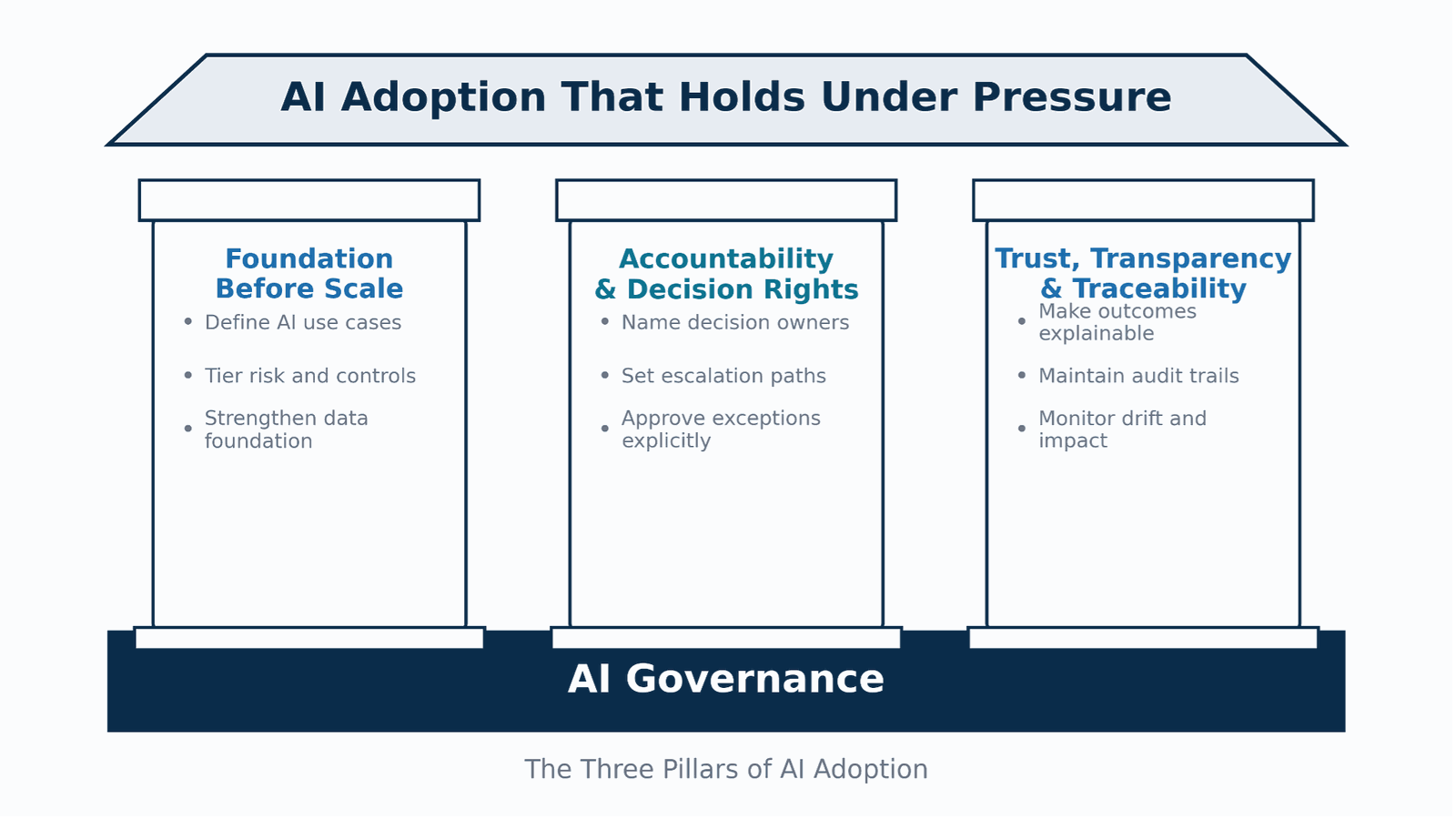
- The Three Pillars of AI Adoption framework helps leaders scale AI without losing control of decision ownership, evidence, escalation, and trust.
The Three Pillars of AI Adoption
This framework has one purpose: ensure AI-driven decisions hold under pressure, across scale, automation, and scrutiny.
Why AI Governance Must Move From Tools to Decisions
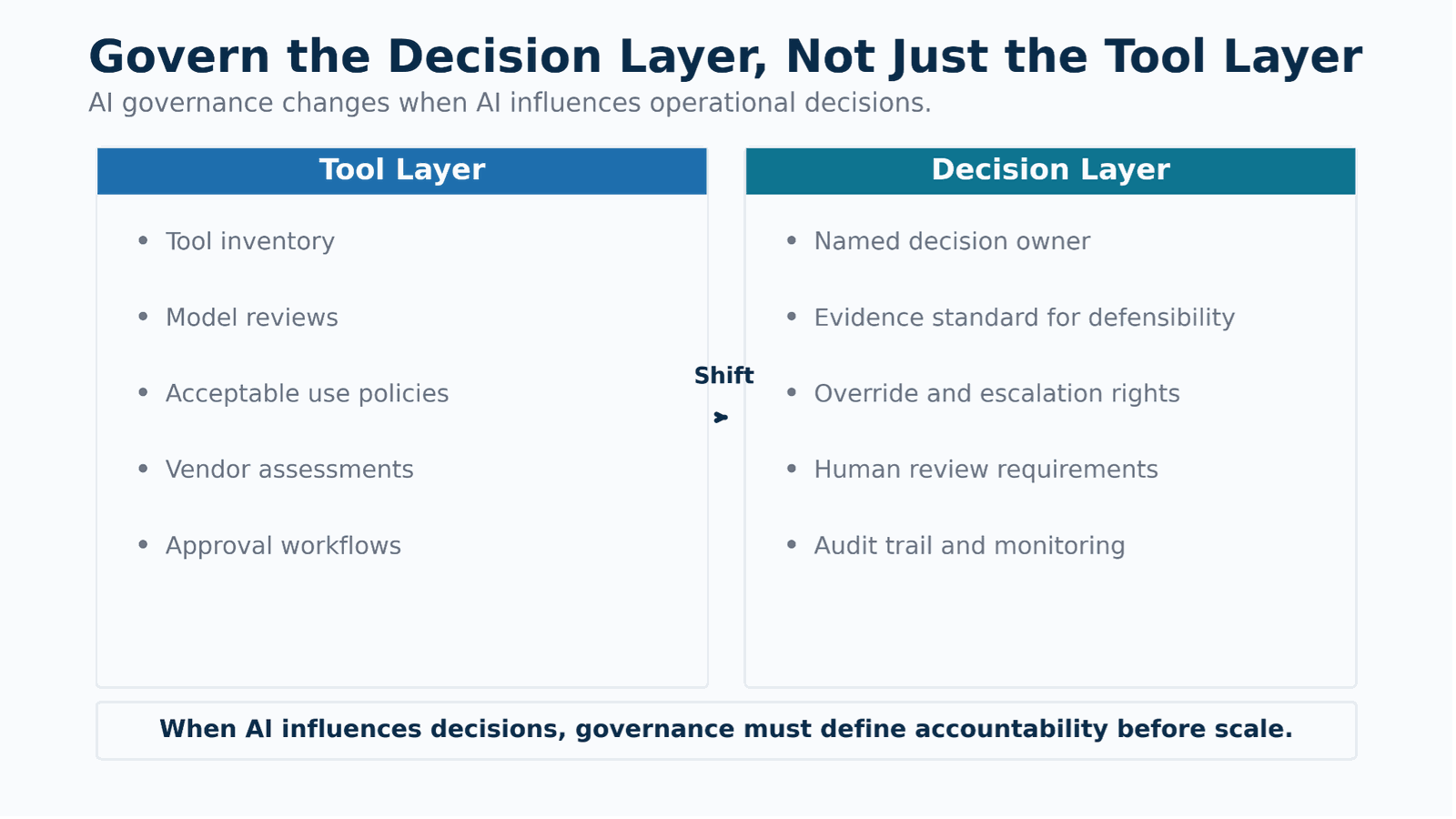
AI governance becomes materially different when AI starts influencing operational and customer-facing decisions. A model that summarizes information is one thing. A model that shapes hiring, pricing, credit, compliance, or customer response is something else entirely.
For CIOs and CDOs, the practical question is not only whether an AI system was reviewed. The question is whether the enterprise can defend the decision the AI now influences.
In global organizations, this is where governance programs fail quietly. Accountability is distributed informally across IT, Data, Legal, Risk, and the business. On paper it looks reasonable. Under pressure it disappears.
Pillar 1: Foundation Before Scale
CIOs and CDOs are pressured to move from pilots to scale quickly. The foundation pillar ensures AI is deployed into an environment that supports repeatable and defensible outcomes.
What this pillar means in practice
- Define the AI decisions that matter most, not just the models that exist.
- Tier use cases by risk and business criticality, then align controls by tier.
- Strengthen enterprise data readiness where it actually impacts decisions: definitions, quality thresholds, lineage, and access controls.
- Establish a minimal evidence standard for every AI-influenced decision: what must be true before scale.
Signals you are missing the foundation
- Use cases are prioritized by enthusiasm or vendor capability rather than decision criticality.
- Data governance is lacking and not enterprise-grade.
- Data quality is treated as cleanup, not infrastructure.
- Leadership asks if AI is accurate, but cannot name the authoritative data sources or thresholds that define acceptable error.
A real-world example
A large insurer scaling AI across claims and fraud workflows discovered that inconsistent definitions and fragmented records were undermining model confidence. The constraint was not model performance. It was the absence of enforced ownership, lineage, and decision-ready data. Strengthening the foundation improved definition consistency, reduced rework, and increased confidence in the decisions those models supported.
Pillar 2: Accountability and Decision Rights
Accountability is the core differentiator between aspirational AI governance and operational AI governance. Policies do not absorb outcomes. Leaders do.
The decision-owner rule
Every AI-influenced decision needs one named outcome owner. This does not mean one person owns everything. It means one person owns the decision and its consequences, with explicit rights to accept risk, require changes, or halt use.
Minimum accountability design
- Name the decision owner and make their authority explicit.
- Define who can override AI, when, and with what evidence.
- Establish escalation paths for uncertainty, exceptions, and harm signals.
- Clarify what is being delegated: judgment, triage, recommendation, or automation.
- Define a defensibility standard: what evidence proves the outcome held under scrutiny.
A practical warning
If accountability is distributed informally across functions, then finger-pointing and disharmony are sure to follow. IT and Data blame each other. Risk demands controls. The business pushes speed. Governance becomes coordination, not decision integrity.
A real-world example
A global financial services organization launched a high-visibility AI initiative that passed model review but struggled during rollout because no one owned exception handling when outcomes were challenged. Decision rights were implied. Escalations became political. Progress stalled until leadership clarified who owned the decision, who could override it, and what evidence was required to defend the outcome.
Pillar 3: Trust, Transparency, and Traceability
Trust is not messaging; it is an operating condition. It is created when outcomes are explainable, evidence is preserved, and the organization can demonstrate how decisions were made.
What trust requires
- Transparency: clear understanding of model purpose, limits, and decision context.
- Traceability: an audit trail from data sources to decision outcomes.
- Continuous monitoring for drift, bias signals, and performance degradation.
- Controls that exist inside systems and workflows, not only in documentation.
What global organizations should prioritize
A global governance posture works best when it is principle-based and decision-centered. Standards and regulations vary by region, but the decision-layer requirements for ownership, evidence, and escalation remain stable across jurisdictions.
A real-world example
A large federal agency scaled GenAI-enabled workflows quickly, then encountered audit and compliance friction because evidence standards were undefined. Once traceability and monitoring were engineered into the workflow, adoption accelerated with fewer reversals and greater confidence from oversight stakeholders.
Closing Thoughts
The organizations that succeed with AI will not be the ones with the most governance activity. They will be the ones that make better decisions faster, with ownership, evidence, and trust built into the operating model.
AI adoption does not have to stall under the weight of risk, ambiguity, or fragmented ownership. CIOs and CDOs can help their organizations move faster when they build on the right foundation, assign clear accountability and decision rights, and create trust through transparency and traceability. These three pillars turn AI governance from a constraint into an executive operating system for scale. When leaders define the decisions that matter, clarify who owns them, and preserve the evidence needed to defend them, AI can move beyond pilots and become a source of durable enterprise advantage.