
Executive Summary
- The first 180 days are the CDO’s credibility window. They determine whether data becomes a strategic enterprise function or remains a coordination exercise.
- New CDOs inherit fragmented ownership, inconsistent definitions, data quality issues, underpowered governance, analytics demand, and rising pressure to enable AI.
- The fastest path to executive trust is not a broader data inventory. It is clarity about decision-critical data, ownership, authority, quality thresholds, lineage, and accountability.
- CDOs create momentum when they connect data governance, data quality, metadata, master data, AI readiness, and business value into one executive agenda.
The CDO’s first mandate is not to own every data problem. It is to define the decisions that data must support, the owners who must be accountable, and the evidence required for trust.
The first 180 days are a credibility window
Every new CDO inherits two data organizations at once: the formal data program described in strategy documents, and the informal network of spreadsheets, local definitions, manual reconciliations, ownership disputes, and data workarounds that actually shape decisions.
That is why the first 180 days matter so much. They are not simply a period to learn the landscape. They are the window in which the CDO establishes whether data leadership will be strategic or administrative.
A new CDO does not need to fix every data issue immediately. But the CDO does need to create early clarity about which data matters most, who owns it, where quality problems create business exposure, and how data will support analytics, governance, and AI at scale.
Why 180 days, not 90
The conventional executive transition frame is the first 90 days, drawn from general leadership onboarding. For a CDO, 90 days is enough to map the landscape and meet stakeholders. It is rarely enough to clarify data ownership, establish governance authority, and prove which data the enterprise can trust. Those problems are structural, and structure takes longer to reset than impressions do. The first 180 days are the horizon in which a CDO moves from diagnosis to a data agenda the organization will actually support.
The mistake: treating data as a technical inventory instead of a decision asset
Many CDO transitions begin with data catalogs, platform reviews, dashboard inventories, governance committees, data quality scorecards, and stewardship discussions. Those activities are useful, but they are not enough. They describe the data environment. They do not always reveal why the business still does not trust the data.
The deeper issue is often authority. Data quality does not improve when ownership is implied. Governance does not hold when escalation is political. AI readiness does not appear because a data catalog exists. Enterprise trust grows when the organization knows which data is authoritative, who owns it, what quality threshold is acceptable, and where conflict ends.
The CDO who starts only with a data inventory may inherit the organization’s existing ambiguity. The CDO who starts with a decision-critical data inventory begins to expose where data must support value, risk, accountability, and trust.
What new CDOs inherit now
The CDO role has expanded. Boards and executive teams now expect data leaders to improve data quality, strengthen governance, enable analytics, prepare the enterprise for AI, reduce risk, and prove measurable business value.
At the same time, many CDOs inherit fragmented ownership, inconsistent definitions, weak lineage, uneven metadata practices, underpowered stewardship, and business expectations that exceed the organization’s current data discipline.
The result is a dangerous transition pattern: the CDO is expected to create enterprise value before the enterprise has clarified the ownership model, governance authority, and data foundation required for durable execution.
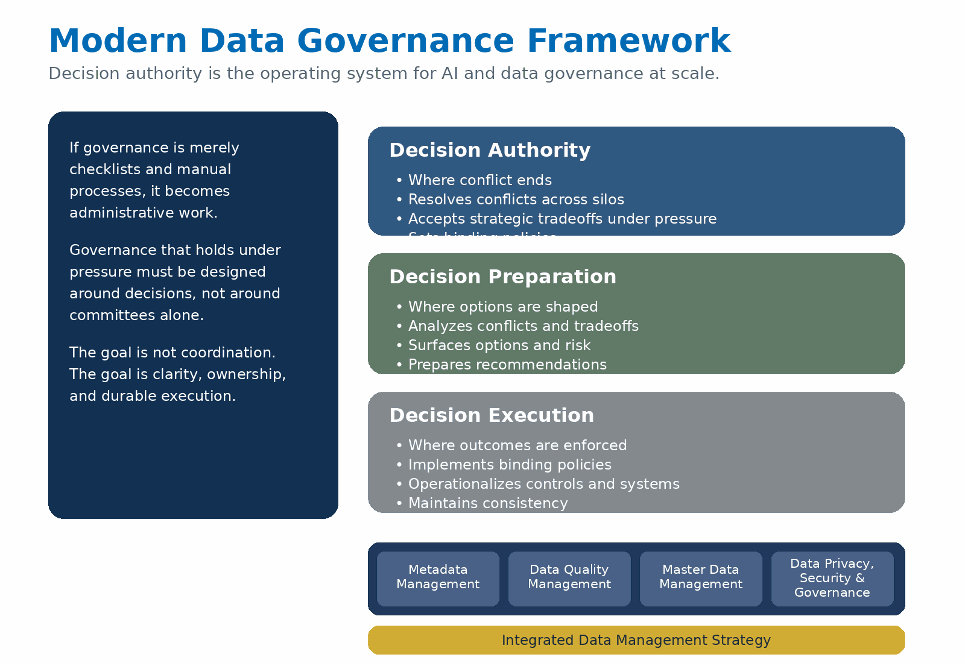
Figure 1. The Modern Data Governance Framework connects authority, preparation, and execution.
A practical first-180-day agenda for CDOs
A disciplined CDO transition does not require the new data leader to solve every data issue at once. It requires a sequence that builds executive trust while identifying where data has the greatest impact on decisions, risk, AI readiness, and value.
Days 1 to 30: Clarify the executive mandate
Determine what the CEO, board, CIO, CAIO, business leaders, risk, legal, and finance actually expect from the data function. Identify where expectations conflict and where the CDO is being asked to absorb organizational ambiguity.
Days 31 to 60: Identify decision-critical data
Find the data domains that matter most to executive decisions, customer outcomes, regulatory exposure, operational performance, analytics, and AI. Move the conversation from all data to the data that changes outcomes.
Days 61 to 90: Diagnose governance authority
Assess whether governance has real decision rights or only meeting activity. Clarify ownership, stewardship, escalation, policy authority, and where conflict should end.
Days 91 to 120: Stabilize visible data risks
Surface quality, lineage, metadata, master data, privacy, and access issues that could undermine trust, reporting, AI adoption, regulatory confidence, or executive credibility.
Days 121 to 180: Commit to an executive data roadmap
Translate findings into a focused roadmap that ties data governance, quality, metadata, master data, analytics, and AI readiness to business value and executive priorities.
Why CDO success now depends on AI readiness
AI has changed the CDO transition. Weak definitions, fragmented records, missing lineage, unclear ownership, and inconsistent quality thresholds can remain hidden in traditional reporting environments. AI exposes them quickly.
The question for the CDO is not whether the enterprise has enough data. Most organizations have more data than they can govern. The more important question is whether the enterprise has decision-ready data: trusted, governed, traceable, owned, and fit for the decisions AI and analytics will influence.
That is why data governance, data quality, metadata, master data, privacy, security, and AI governance cannot be treated as separate programs. They are one integrated blueprint viewed from different angles.
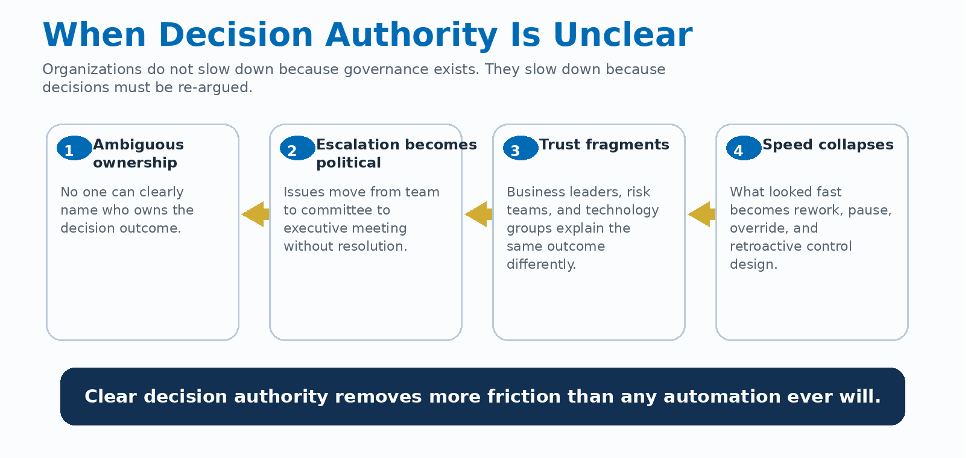
Figure 2. When decision authority is unclear, speed collapses.
The first-180-day CDO diagnostic
A CDO who wants to move fast should begin by asking sharper questions. These questions reveal whether the organization has a data quality problem, a governance problem, a technology problem, or a decision problem hiding underneath the data agenda.
- Which data domains are most critical to executive decisions, regulatory exposure, customer outcomes, operational performance, and AI adoption?
- Who owns the business meaning, quality threshold, and acceptable use of those data domains?
- Where do definitions, metrics, master data, or lineage break down across functions?
- Which governance decisions are stuck because authority is unclear or shared by committee?
- Where is data quality treated as cleanup rather than infrastructure for decisions?
- Which AI initiatives depend on data that is not yet trusted, traceable, or decision-ready?
- What evidence would prove, six months from now, that the CDO’s agenda is creating enterprise value?
Data governance that holds under pressure is designed around decisions, not committees alone.
How new CDOs create momentum without owning every data problem
The first 180 days are not the time for the CDO to become the owner of every unresolved data issue. That path leads to frustration, diluted authority, and a data function that becomes a complaint desk for the enterprise.
The CDO creates momentum by narrowing the agenda to the data that matters most, clarifying where business ownership belongs, surfacing risks before they become executive surprises, and tying governance directly to decisions, AI readiness, and measurable value.
The best CDO transitions create a different kind of confidence. Business leaders understand what they own. Technology teams understand which capabilities matter most. Risk and compliance leaders understand how evidence will be preserved. Executives understand how data will support speed, trust, and value.
What boards and CEOs should expect from a new CDO
A strong CDO should not spend the first 180 days simply reporting on data assets, dashboards, governance meetings, or platform activity. Boards and CEOs should expect a clear view of decision-critical data, ownership gaps, quality risks, AI readiness constraints, governance authority, and the enterprise choices required to create trusted data at scale.
The CDO should be able to explain not only what the data organization is doing, but what the enterprise needs to decide. That is where the role becomes strategic.
From transition to trusted data leadership
The first 180 days determine whether the CDO inherits the existing data debate or resets it. The most successful CDOs do not wait for enterprise clarity to appear. They create it.
They identify the data that matters most, clarify ownership, strengthen governance authority, expose quality and lineage risks, and build the foundation required for analytics and AI governance to scale with confidence.
Data leadership succeeds when governance, quality, metadata, master data, AI readiness, and decision authority operate as one agenda. That is how a new CDO turns transition into enterprise advantage.
For executives navigating this transition directly, the CDO First 180 Days Advisory provides independent counsel through the first six months.