
Reengineering architecture, governance, and accountability for trusted data, scalable AI, and faster decisions. Modern platforms promise a better future, but pressure does not test the project plan. It tests the operating model. Data modernization holds only when the way data supports decisions is modernized too, not merely migrated.
Data modernization has become one of the most important executive priorities in the enterprise.
CIOs, CDOs, CAIOs, and board members are under pressure to reduce complexity, improve performance, enable AI, strengthen governance, and help the business move faster. Modern platforms promise a better future. Cloud data platforms, lakehouses, data fabrics, automation, and AI-enabled capabilities all offer meaningful potential.
But too many data modernization programs are still defined by technical milestones.
- Platforms replaced.
- Data migrated.
- Pipelines rebuilt.
- Costs shifted.
- New tools implemented.
Those milestones matter, but they do not determine whether modernization will hold under pressure.
Pressure does not test the project plan. Pressure tests the operating model.
When a critical decision is challenged, when an AI initiative scales, when a regulator asks for lineage, when the board questions confidence in a metric, or when executives discover conflicting answers across business units, the real question is not whether the enterprise has modern technology.
The real question is whether the organization has modernized the way data supports decisions.
That is where many modernization efforts fall short.
The Modernization Misunderstanding
Most data modernization programs are sold on a familiar promise:
- Reduce cost.
- Consolidate platforms.
- Improve performance.
- Enable analytics.
- Prepare for AI.
- Increase agility.
Those are valid goals. But they are not enough.
In practice, many organizations move old complexity into a new environment. Redundant pipelines remain. Conflicting definitions persist. Analytical environments continue acting as informal systems of record. Operational applications remain dependent on reporting layers. Data quality issues are carried forward. Lineage is still difficult to reconstruct. Ownership remains unclear.
The platform is new. The firefights are familiar.
This is why modernization cannot be treated as a technology replacement program. Technology can improve capability, but it cannot compensate for structural ambiguity. Modern platforms amplify whatever foundation already exists.
If the foundation is strong, modernization accelerates value.
If the foundation is fragile, modernization scales fragility.
Data Modernization Is an Operating Model Transformation
True data modernization is not defined by where data is stored.
It is defined by whether the organization can use data to make trusted decisions faster.
That requires more than migration. It requires a deliberate redesign of the architecture, governance, quality, accountability, and decision structures that determine how data is created, moved, trusted, and used.
A modern data organization is not simply one with newer platforms. It is an organization where:
- Authoritative data sources are known and respected.
- Data lineage can be reconstructed quickly.
- Quality controls are built into the flow of data.
- Ownership is explicit.
- Decision rights are clear.
- AI initiatives scale on trusted data.
- Executives can act without endless reconciliation cycles.
This is the central shift executives need to make:
Upgrading changes technology. Reengineering changes outcomes.
Data modernization that upgrades preserves complexity. Data modernization that reengineers eliminates fragility.
What Breaks Under Pressure
Modernization rarely fails during migration.
It fails during escalation.
The warning signs usually appear when data is needed for a high-stakes decision. A customer outcome is challenged. A regulator asks for evidence. An executive dashboard shows conflicting numbers. A major AI use case begins scaling beyond pilot stage. A business process depends on data no one fully owns.
At that moment, the CIO or CDO is often forced to confront structural problems that were never resolved:
- Conflicting definitions across systems
- No clear authoritative source of truth
- Lineage that cannot be reconstructed quickly
- Operational applications depending on analytical layers
- Single points of failure hidden in legacy workflows
- Data quality issues surfacing in executive forums
- AI initiatives amplifying unresolved data problems
- Tribal knowledge required to explain how systems actually work
These are not migration artifacts.
They are structural defects.
If they are not addressed directly, they move into the modern environment. The organization may have a better platform, but it still has the same ambiguity, redundancy, quality issues, and accountability gaps.
That is why data modernization strategy must start with the conditions that cause friction in decision-making.
Modernization Should Remove Decision Friction
Modernization creates value when it removes the conditions that slow decisions.
- Conflicting definitions are replaced by shared meaning.
- Unclear ownership is replaced by explicit accountability.
- Fragile lineage is replaced by traceability.
- Redundant pipelines are replaced by reusable architecture.
- Data quality issues are addressed before they reach executive decisions.
- AI initiatives scale on a foundation leaders can trust.
This is the real opportunity.
Data modernization is not just a move to a new platform. It is the opportunity to redesign how data supports decisions across the enterprise.
When modernization is done well, leaders spend less time reconciling answers and more time acting on them.
The Three Pillars of Data Modernization That Holds
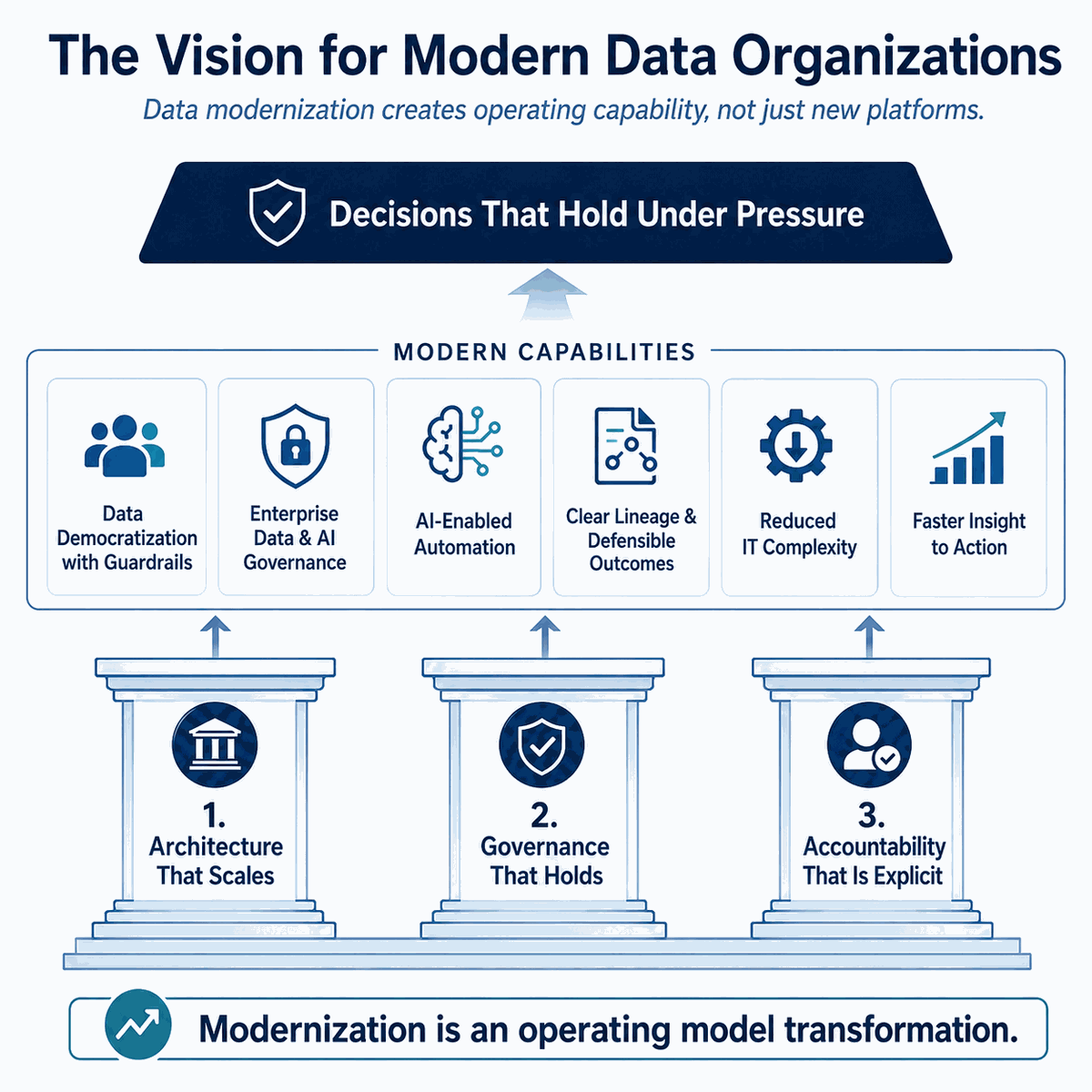
Enterprise data modernization holds under pressure when three capabilities mature together:
- Architecture.
- Governance and data quality.
- Accountability.
If any one of these is weak, modernization becomes fragile.
1. Architectural Integrity
Modernization holds when architecture is redesigned, not merely migrated.
This means leaders must address the structural design of the data environment. Are operational and analytical workloads properly separated? Are authoritative systems of record clearly defined? Are domains integrated, or is the enterprise replicating silos into new platforms? Are there single points of failure? Are pipelines reusable, or are they custom-built for each downstream demand?
A modern data architecture should be built for durability, integration, and scale.
Not convenience. Not short-term reporting workarounds. Not one-off AI experiments.
Architecture must support the way the business needs to operate, govern, automate, and decide.
2. Embedded Data Governance and Data Quality
Modernization holds when governance is structural, not symbolic.
Too many organizations treat data governance as documentation, committee structure, or policy language. That is not enough. Governance must be built into the flow of data.
That means named ownership, standardized definitions, metadata capture, lineage, quality controls, validation rules, and monitoring must be integrated into the architecture and operating model.
Data quality cannot remain a downstream cleanup exercise.
By the time poor-quality data reaches an executive decision, an automated process, or an AI model, the organization is already exposed.
Modern data quality must be proactive. It must be designed into ingestion, transformation, usage, and monitoring.
Data quality must hold under pressure, not just in reports.
3. Scalable Accountability and Modern Capability
Modernization holds when decision accountability scales with technology.
This is often the missing piece.
Organizations can invest heavily in platforms, data products, dashboards, and AI capabilities while still avoiding the harder questions:
- Who owns each critical data domain?
- Who resolves definition conflicts?
- Who approves changes to authoritative data?
- Who is accountable for data quality?
- Who can override automated or AI-enabled decisions?
- Who defends a decision under audit, regulation, litigation, or executive scrutiny?
When accountability remains ambiguous, modernization does not reduce friction. It creates new escalation paths.
When accountability is explicit, decisions move faster because the organization knows where authority sits.
Modern capabilities only create value when accountability is engineered first.
The Data Modernization Maturity Path
Modernization does not become durable through migration alone.
It becomes durable when architecture, governance, and accountability mature together.
Executives should think about data modernization as a maturity path, not just a project plan.
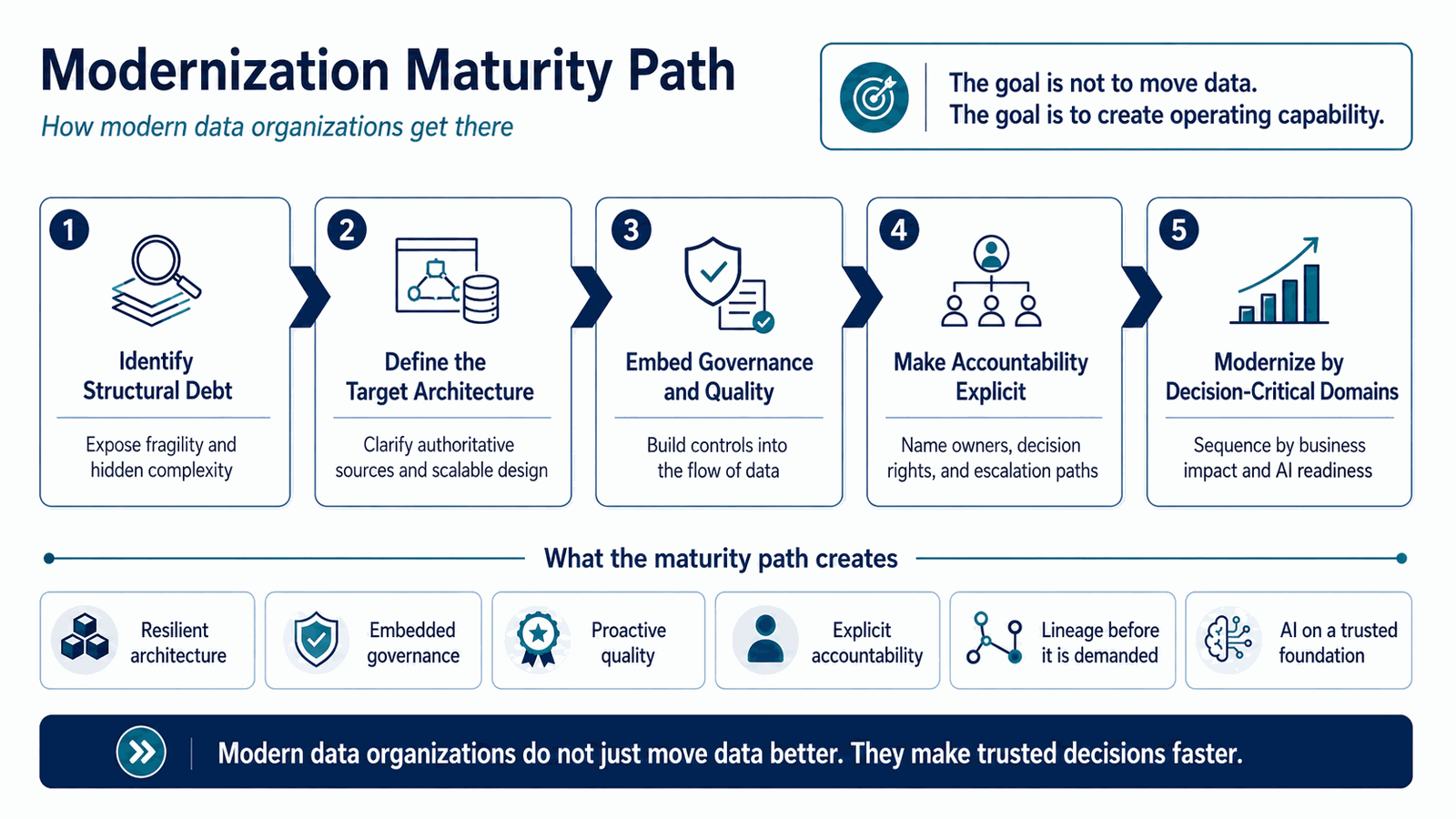
Step 1: Identify Structural Debt
Every modernization effort inherits structural debt.
Before platforms are replaced, leaders need to identify where the current environment is fragile.
Where are operational systems depending on analytical environments? Where are analytical warehouses acting as systems of record? Where do redundant pipelines exist? Where do business definitions conflict? Where are single points of failure hidden? Where does tribal knowledge keep critical processes running?
These conditions do not disappear during modernization.
Unless there is a plan to remove them, they are inherited by the modernization program.
Step 2: Define the Target Architecture Before Migration
Modernization should begin with architectural clarity.
Leaders need to define authoritative sources of data, operational versus analytical workloads, where data should be integrated and reused, how lineage will be maintained, where quality controls belong, what redundancy should be eliminated, and what must scale for AI adoption.
Without this clarity, modernization becomes expensive relocation.
The organization moves data, but not necessarily capability.
Target architecture should guide technology decisions, not follow them.
Step 3: Embed Governance and Quality Into the Flow of Data
Governance cannot sit outside modernization.
It must be built into how data is created, moved, validated, transformed, monitored, and used.
This requires named data ownership, standardized business definitions, metadata captured in the pipeline, lineage designed into the architecture, quality rules applied before decisions depend on the data, and continuous monitoring and control validation.
Modernization holds when governance and quality are built into the flow of data.
Step 4: Make Accountability Explicit
Modernization does not reduce friction if accountability stays ambiguous.
Leaders must define who owns each critical data domain, who resolves definition conflicts, who approves changes to authoritative data, who is accountable for data quality, who can override automated decisions, and who defends decisions under scrutiny.
This is not bureaucracy.
It is what allows decisions to move faster.
Clear accountability prevents constant escalation, repeated alignment meetings, and executive hesitation.
Modernization accelerates decisions only when ownership is clear.
Step 5: Modernize by Decision-Critical Domains
Not all data should be modernized with the same urgency.
The highest-value modernization efforts begin with the domains that matter most to enterprise decisions.
These may include domains tied to revenue, customer experience, operational resilience, regulatory exposure, financial reporting, executive performance metrics, AI and automation use cases, or known quality, lineage, and ownership risk.
This approach creates visible value faster and keeps modernization tied to business impact.
Modernization should be sequenced around the decisions the enterprise most needs to trust.
Why Data Modernization Matters for AI Readiness
AI has raised the stakes for data modernization.
AI does not fix weak data environments.
It exposes them.
When organizations scale AI on top of fragmented, poorly governed, or poorly understood data, the risks compound quickly. Flawed data can drive flawed recommendations. Inconsistent definitions can create conflicting outputs. Weak lineage can make decisions difficult to explain. Unclear ownership can turn AI outcomes into executive exposure.
AI readiness is not just a model issue.
It is a data modernization issue.
Enterprise AI requires trusted data, clear lineage, scalable architecture, embedded governance, proactive data quality, and explicit accountability.
Without those conditions, AI pilots may succeed, but enterprise adoption will struggle to scale.
Modernization is what allows AI to move from experimentation to trusted operating capability.
The Executive Diagnostic for Data Modernization
Executives do not need to start with a technical inventory.
They can begin with a simple stress test.
Ask these questions:
- Can we identify authoritative sources for our most critical data domains?
- Can we explain where critical data came from, how it changed, and who approved it?
- Can our architecture support reuse without fragile workarounds?
- Are quality controls embedded before decisions depend on the data?
- Do we know who owns each critical data domain?
- Do we know who resolves conflicts when definitions differ?
- Can we reconstruct a critical decision months later without scrambling?
- Do leaders trust the data enough to act without parallel validation cycles?
- Can AI initiatives scale without destabilizing trust?
If the answer to these questions is unclear, the organization may have a data modernization program, but it does not yet have a modern data operating model.
What Modern Data Organizations Look Like
Modern data organizations do not simply move data faster.
They make trusted decisions faster.
They are built on architecture that scales, governance that holds, accountability that is explicit, data quality that is engineered, lineage that is available before it is demanded, and AI that operates on a trusted foundation.
In these organizations, modernization creates operating capability.
- Data becomes more reliable.
- AI becomes more trustworthy.
- Executives gain confidence.
- Technology teams reduce redundancy.
- Business leaders spend less time debating definitions.
- Decision-making accelerates.
- Risk becomes easier to explain and manage.
This is the real promise of data modernization.
Not a new platform. Not a cleaner migration. Not a better dashboard.
A stronger enterprise decision system.
Data Modernization Is a Leadership Decision
The organizations that succeed with data modernization will not be the ones that simply spend the most on platforms.
They will be the ones whose leaders understand that modernization is a business, governance, architecture, and accountability transformation.
CIOs, CDOs, CAIOs, and board members need to ask a higher-quality question.
Not simply: What platform should we move to?
But: What operating capability must modernization create?
The answer should include trusted data, resilient architecture, embedded governance, proactive quality, explicit accountability, scalable AI, and decisions that hold under pressure.
That is the future of enterprise data modernization.
And it is the difference between moving data and modernizing the organization.
Advisory Support for Data Modernization Leaders
For many organizations, the hardest part of data modernization is not recognizing the need for change.
It is knowing where to begin, how to sequence the work, and how to make sure modernization produces business capability rather than simply technical movement.
That requires an executive-level view of architecture, governance, data quality, accountability, operating model design, and AI readiness.
Dr. David Marco advises CIOs, CDOs, CAIOs, and executive teams on data modernization strategies that hold under pressure. His work helps leaders identify structural debt, define modernization priorities, embed governance and data quality into the operating model, clarify accountability, and create the foundation needed for trusted AI and faster decisions.
If your organization is preparing for data modernization, struggling to convert modernization investment into business value, or trying to determine whether your data foundation can support AI at scale, this is the right time to step back and assess whether the modernization strategy is built to hold.
Modernization is not the destination. It is the operating capability that lets the enterprise move with confidence.