
What boards and the C-suite must get right before AI scales.
Executive Summary
Most AI and data governance programs do not fail first as policy problems. They fail as decision authority problems. When ownership is vague, escalation turns political, trust fractures, and speed collapses. Real governance begins when boards and executive teams can name who owns the decision, who can override it, who defends it under scrutiny, and where conflict ends.
The mistake most leaders still make
Most organizations still treat AI and data governance as process problems. They build committees, intake forms, review checklists, policies, and documentation. On paper, this looks mature. In practice, it often collapses at the exact moment leadership needs clarity.
The reason is simple. Governance does not fail first as a policy problem. It fails as a decision authority problem. When an AI-driven outcome is challenged, the real questions are not procedural. The real questions are:
- Who owns the decision?
- Who can override it?
- Who answers when the outcome is questioned?
- Who accepted the tradeoff?
- Who defends it under audit, litigation, or board scrutiny?
If those questions are not clear before pressure arrives, the organization does not have governance. It has activity, and activity does not hold under pressure.
Approval is not accountability
Many organizations design governance around approvals. A committee reviews the use case. Risk signs off. Legal signs off. Compliance signs off. Technology signs off. Everyone participates. No one owns the decision.
Approval-based structures create the appearance of control while avoiding the one thing that matters most: explicit accountability for outcomes. Real governance begins when the organization names, in advance, who has authority over the decision itself.
That is the line between governance that is decorative and governance that holds.
Why decision authority matters more in AI
Traditional analytics could survive a surprising amount of organizational ambiguity. Manual quarterly reconciliation can temporarily clear up ambiguity. AI-driven decisions do not have a quarterly reconciliation cycle. AI increases decision velocity, compresses time, and magnifies weak ownership. What might remain manageable as a slow-moving reporting issue becomes a leadership problem the moment AI begins influencing outcomes at enterprise scale.
This is why many organizations misread AI governance. They believe the primary challenge is model validation. The primary challenge is whether the enterprise can maintain authority, accountability, and trust once AI-driven decisions operate across functions, departments, geographies, and risk boundaries.
If leadership cannot explain how a decision was made, who owned it, what data informed it, what tradeoffs were accepted, and how an override occurs, then AI has already outrun governance.
The Modern Data Governance Framework
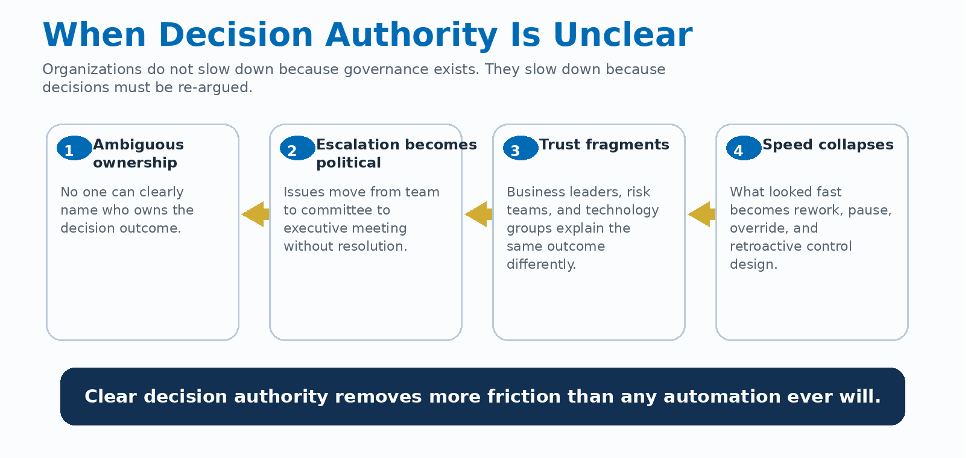
Over the years, I have found that governance only becomes durable when it is designed around three linked layers: decision authority, decision preparation, and decision execution.
Decision authority is where conflict ends. It is the layer that accepts tradeoffs, resolves cross-functional disputes, and sets binding policies. Decision preparation is where clarity is built. This is where data quality, metadata, master data, privacy, security, and risk analysis shape the options leadership will choose among. Decision execution is where outcomes are enforced through platforms, controls, automation, and operating discipline.
The mistake most organizations make is treating these as separate conversations rather than an integrated decision-making framework. Often, organizations assign responsibility without authority or the needed preparation, resulting in compliance theater.
The framework only works when these layers are connected through an integrated data management strategy. That is what turns governance from coordination into decision infrastructure.
The four questions every board should ask
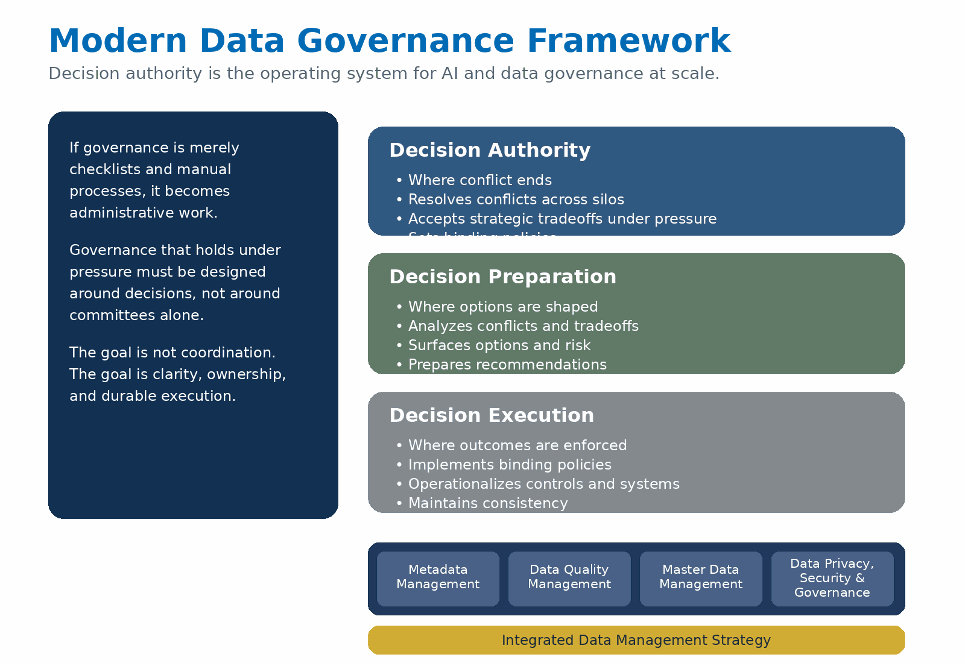
Boards and executive teams do not need more committee updates. They need sharper questions.
First, who is accountable for the decision outcome, not just the model or workflow. Second, who can override the decision, under what conditions, and how is that override recorded. Third, who explains and defends the decision under audit, litigation, regulatory challenge, or board scrutiny. Fourth, where does escalation end, and who has final authority to resolve conflict.
If those answers are vague, shared by committee, or reconstructed after the fact, the governance system is weaker than leadership requires.
How decision authority breaks down in practice
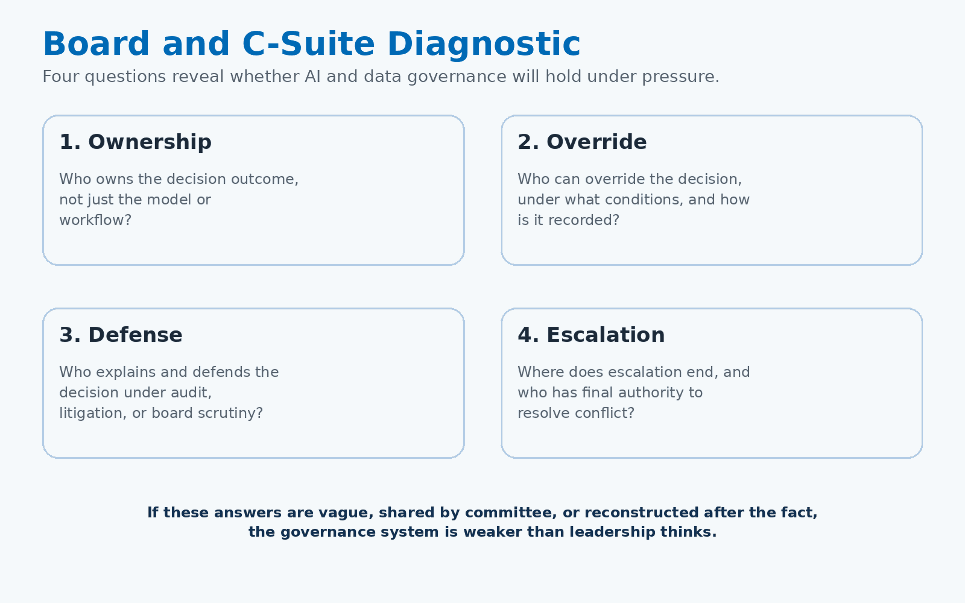
When decision authority is unclear, the breakdown follows a familiar pattern. Ownership becomes ambiguous. Escalation becomes political. Trust fragments across business, risk, and technology teams. What looked like speed turns into rework, pause, override, and retroactive control design.
Leaders often misdiagnose this as a technology problem or a culture problem. In practice, it is typically an operating model problem. Governance slows only when decisions must be re-argued because ownership was never made explicit.
That is why clear decision authority removes more friction than almost any automation investment ever will.
What real decision authority frameworks include
A real decision authority framework does not start with forms. It starts with design. At minimum, it should define explicit decision ownership, decision rights and boundaries, override logic, escalation architecture, and reconstructable traceability. In one case, a significant data error at a large financial services organization nearly reached a regulatory filing. Had it gone out, the issue could have created exactly the kind of public, board-level exposure executives assume governance is designed to prevent.
For every material AI-influenced decision, there must be a clearly named business owner with accepted accountability for the outcome. The organization must define who decides, who advises, who approves exceptions, and who has no authority, even if they participate in the process. Override paths should be explicit and reviewable. Escalation paths should be short, bounded, and final. And the enterprise must be able to reconstruct, later and under pressure, what data was used, what assumptions were active, what controls applied, and who owned the outcome.
What boards and the C-suite should do now
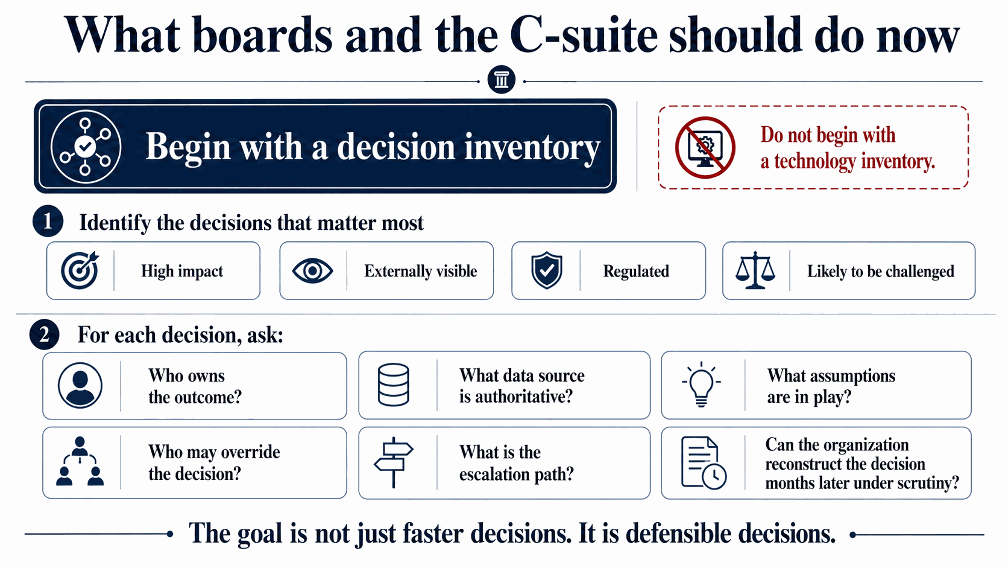
Do not begin with a technology inventory. Begin with a decision inventory. Identify the decisions that matter most, especially those that are high impact, externally visible, regulated, or likely to be challenged. For each one, ask who owns the outcome, what data source is authoritative, what assumptions are in play, who may override the decision, what the escalation path is, and whether the organization can reconstruct the decision months later under scrutiny.
The goal is not to create more governance ceremony. The goal is to create governance that reduces hesitation. When decision authority is explicit, fewer issues need escalation. Fewer decisions need to be reargued. Fewer exceptions turn political. Leaders act faster because they trust the structure around the decision.
The hard truth
Most organizations do not fail because they lack AI ambition. They fail because they try to scale AI without first deciding how authority will hold when outcomes are challenged. That is not a technical gap. It is an executive design failure.
If no one truly owns the decision, no one will trust it when pressure arrives. And if leaders do not trust the decision, scale will stop there.
Defining decision authority takes time and effort, but it is not an impossible task. It requires discipline, explicit design, and strong executive leadership.