
What Directors Should Ask Before Data, AI, and Decision Risk Scale Beyond Control
Data modernization is not a technology refresh. It is an enterprise oversight issue because it determines whether management can trust, explain, and defend the decisions the organization makes.
Data modernization is often presented to boards as a technology initiative: a cloud migration, a data platform replacement, a cost-reduction program, or a foundation for analytics and AI. Those descriptions are partly correct, but they are too narrow for board oversight.
For directors, the central question is not whether management is modernizing the data environment. The central question is whether modernization is reducing enterprise risk, strengthening decision confidence, and creating the operating capability required for scalable AI.
Modernization does not hold because the platform is new. It holds when architecture, governance, data quality, and accountability are reengineered together. Boards do not need to manage the technical details, but they do need to know whether management is treating modernization as a technology project or as a transformation of the enterprise decision system.
That distinction matters because when modernization fails, the consequences rarely stay technical. They appear as conflicting executive metrics, delayed decisions, failed AI initiatives, operational disruption, regulatory exposure, customer impact, reputational damage, and loss of confidence in management’s ability to explain how critical decisions are made.
Why This Belongs on the Board Agenda
Boards are increasingly overseeing organizations whose most important decisions are data-intensive. Data shapes pricing, underwriting, customer treatment, clinical operations, supply chains, financial reporting, risk models, cyber defense, compliance, automation, and AI-enabled processes.
In that environment, data modernization is no longer an IT investment alone. It is an enterprise capability issue. The board does not need to choose the platform. The board does need to understand whether the organization’s data foundation can support the decisions, controls, automation, and AI use cases management is asking it to support.
- Authoritative data sources
- Data quality and lineage
- Architecture resilience
- Operational dependency risk
- Data governance and ownership
- Decision accountability
- AI readiness
- Audit and regulatory defensibility
If those issues remain unresolved, a new platform can create the appearance of progress while preserving the same underlying exposure. The platform may be new, but the risk remains familiar.
The Board-Level Risk in Tool-First Modernization
Many modernization programs are declared successful when technical milestones are achieved. Data is migrated. Pipelines are rebuilt. Platforms are consolidated. Cloud environments go live. Dashboards are redesigned.
Those milestones matter, but they do not prove that the enterprise has become more resilient, more explainable, or more decision-ready. Pressure does not test the project plan. Pressure tests the operating model.
- When a critical number is challenged, can management explain where it came from?
- When an AI-enabled decision is questioned, can the organization trace the data, assumptions, approvals, and ownership behind it?
- When regulators, auditors, customers, or business leaders ask for evidence, can management reconstruct the decision quickly?
- When the board sees two different answers, does leadership know which one is authoritative?
These are oversight questions. A modernization program that moves data without resolving ambiguity can preserve risk in a more expensive and scalable environment. Modern platforms amplify structural strength. They also amplify structural weakness.
What Breaks Under Pressure
Modernization rarely fails during migration. It fails during escalation. The real test comes when the enterprise is under pressure and leaders need data they can trust.
That pressure may come from a regulatory inquiry, a board risk discussion, a customer challenge, an internal audit, a major operational incident, a financial reporting issue, or an AI outcome that must be explained. At that moment, unresolved structural problems become visible.
- Conflicting definitions across systems
- No clear authoritative source of truth
- Lineage that cannot be reconstructed quickly
- Operational applications dependent on analytical layers
- Single points of failure discovered too late
- Data quality issues surfacing in executive forums
- AI initiatives amplifying unresolved structural flaws
- Tribal knowledge required to explain how the environment actually works
These are not migration artifacts. They are structural defects. If modernization does not remove them, the organization inherits them in the new environment.
The Oversight Reframe: Modernization Should Reduce Decision Risk
The best modernization programs do more than move data. They remove the conditions that slow, weaken, or obscure enterprise decisions.
- Conflicting definitions are replaced by shared meaning.
- Unclear ownership is replaced by explicit accountability.
- Fragile lineage is replaced by traceability.
- Redundant pipelines are replaced by reusable architecture.
- Data quality issues are addressed before they reach executive decisions.
- AI initiatives scale on a foundation leaders can trust.
For boards, this is the most important reframing: data modernization is not just a technology investment. It is a way to improve how the enterprise makes, explains, governs, and defends decisions.
Board question: Is modernization making the enterprise more explainable, resilient, governable, and decision-ready, or is it mainly replacing technology?
Three Pillars Directors Should Watch
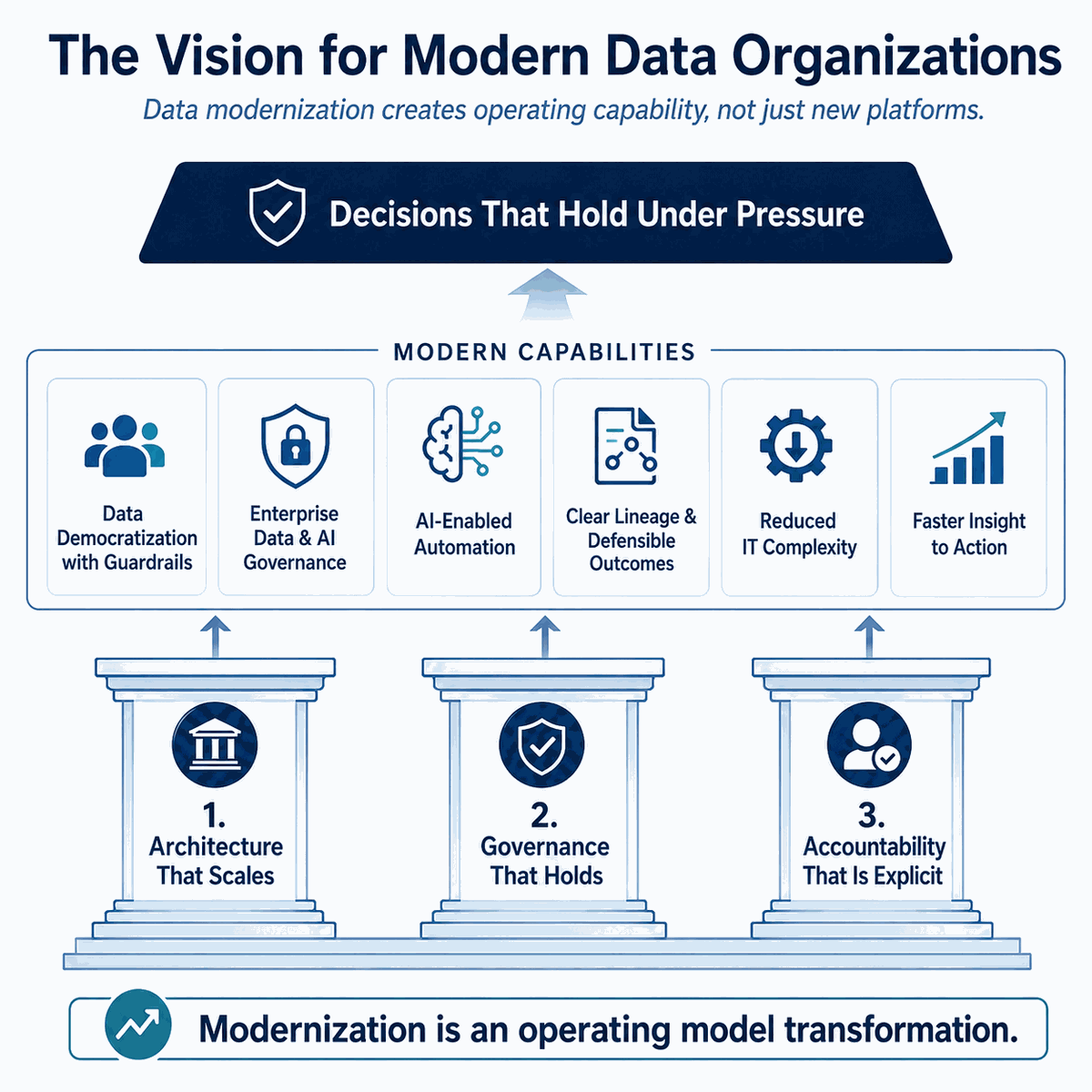
Boards should not oversee every technical detail of modernization. They should understand whether management is addressing the three pillars that determine whether modernization will hold under pressure: architectural integrity, embedded governance and quality, and scalable accountability.
1. Architectural Integrity
A modern data environment must be designed for resilience, integration, reuse, and scale. The board should ask whether management has defined the target architecture before major migration and platform decisions are finalized.
- Are authoritative sources of data clearly defined?
- Are operational and analytical workloads properly separated?
- Are critical systems dependent on fragile analytical layers?
- Are redundant pipelines being eliminated or recreated?
- Are single points of failure being identified and removed?
- Can the architecture support AI, automation, and decision scale?
Architecture is not merely a technical design choice. It determines whether the enterprise can operate reliably as data volume, velocity, complexity, and AI adoption increase.
2. Embedded Data Governance and Data Quality
Boards should be cautious when data governance is described only as policy, documentation, or committee structure. Governance has to be embedded into how data is created, moved, transformed, validated, monitored, and used.
- Named data ownership
- Standardized business definitions
- Metadata capture
- Lineage and traceability
- Quality rules at ingestion and transformation
- Continuous monitoring
- Controls that scale across reporting, operations, analytics, and AI
The board-level issue is not whether data quality problems exist. In large enterprises, they almost always do. The board-level issue is whether management has a disciplined way to detect, prioritize, own, and resolve them before they affect critical decisions.
3. Scalable Accountability
Accountability is often the missing pillar. Organizations may invest heavily in platforms, data products, dashboards, and AI capabilities while avoiding the harder ownership questions.
- Who owns the data?
- Who approves changes to authoritative definitions?
- Who resolves conflicts between business units?
- Who is accountable for data quality?
- Who owns the consequences of data-driven or AI-enabled decisions?
- Who defends the decision when it is challenged?
When accountability is unclear, modernization creates new escalation paths. When accountability is explicit, decisions move faster because the organization knows where authority sits.
Why AI Makes This More Urgent
AI has made data modernization a board-level issue faster than many organizations expected. AI does not fix weak data foundations. It exposes them.
When AI is built on fragmented, poorly governed, or poorly understood data, the risks compound. Inconsistent definitions can produce inconsistent outputs. Poor-quality data can drive poor recommendations. Weak lineage can make outcomes difficult to explain. Unclear accountability can turn AI adoption into executive and board exposure.
Boards should therefore treat AI readiness as inseparable from data modernization. AI pilots can succeed without a fully mature data operating model. Scaled AI cannot.
The Board’s Modernization Oversight Questions
Directors do not need a technical checklist. They need an oversight lens. The following questions can elevate the board conversation from platform progress to enterprise readiness.
- Can management identify authoritative sources for the organization’s most critical data domains?
- Can executives explain where critical data came from, how it changed, and who approved it?
- Are operational systems dependent on analytical environments or reporting layers?
- Where does tribal knowledge still keep critical data processes running?
- Are data quality controls embedded before decisions depend on the data?
- Who owns each critical data domain?
- Who resolves conflicts when definitions differ across business units?
- Can management reconstruct a critical data-driven decision months later without scrambling?
- Can AI initiatives scale without destabilizing trust?
- How is modernization being sequenced around the decisions and risks that matter most to the enterprise?
- What structural debt is being removed, not simply migrated?
- How will the board know modernization has improved decision confidence, not just platform performance?
The Maturity Path Boards Should Expect
A credible modernization strategy should follow a maturity path. It should not begin and end with platform selection.
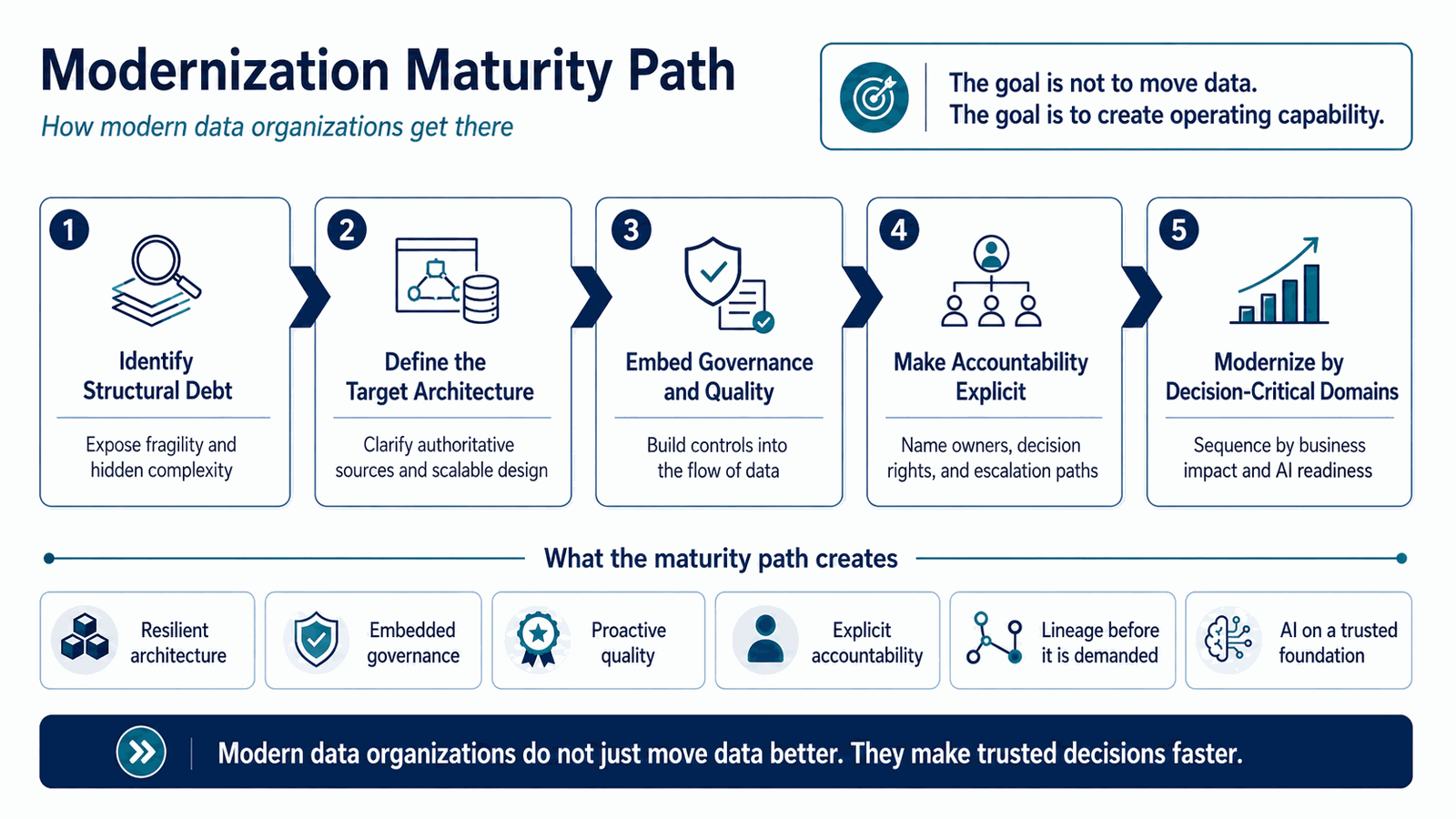
Step 1: Identify Structural Debt
Management should expose redundant pipelines, unclear authoritative sources, conflicting definitions, manual quality fixes, undocumented dependencies, and hidden single points of failure. If structural debt is not identified, it will be carried into the modern environment.
Step 2: Define the Target Architecture Before Migration
The target architecture should clarify authoritative sources, operational and analytical workloads, integration patterns, lineage, quality controls, redundancy elimination, and AI scalability requirements. Without this clarity, modernization becomes expensive relocation.
Step 3: Embed Governance and Quality Into the Flow of Data
Ownership, definitions, metadata, lineage, quality rules, monitoring, and controls should operate inside the modernized environment, not as side processes added after the fact.
Step 4: Make Accountability Explicit
Management should be able to name who owns critical data domains, who resolves conflicts, who approves changes, who owns quality, and who defends decisions under scrutiny.
Step 5: Modernize by Decision-Critical Domains
Modernization should be sequenced around domains tied to revenue, customer experience, regulatory exposure, financial reporting, operational resilience, AI use cases, and known quality or ownership risk.
What a Mature Data Organization Gives the Board
Modern data organizations do not simply move data faster. They make trusted decisions faster.
- Architecture that scales
- Governance that holds
- Accountability that is explicit
- Data quality that is engineered
- Lineage that is available before it is demanded
- AI that operates on a trusted foundation
In a mature environment, executives spend less time debating which numbers are right. Risk discussions are grounded in evidence. AI initiatives are easier to explain. Audit and regulatory requests are less disruptive. Business leaders can act with greater confidence.
That is the board-level value of data modernization: it improves the enterprise’s ability to make decisions that hold under pressure.
The Board’s Role Is Oversight, Not Implementation
Boards should not run data modernization programs. But they should oversee whether management is treating modernization with the right level of enterprise seriousness.
The board’s role is to ensure management is not mistaking technical movement for risk reduction, AI readiness, or decision maturity.
- What business decisions modernization is meant to improve
- What risks modernization is meant to reduce
- What structural debt is being removed
- How governance and quality are being embedded
- How accountability is being clarified
- How AI readiness is being strengthened
- How management will measure decision confidence, not just migration progress
This is where board oversight can create real value. The board can help management elevate modernization from a platform program to an enterprise capability agenda.
Data Modernization Is a Leadership and Governance Issue
Data modernization is one of the most important foundations for enterprise resilience, AI adoption, regulatory confidence, and faster executive decision-making. But modernization only creates value when it addresses the operating model beneath the technology.
Boards should therefore ask a higher-quality question. Not simply: are we modernizing our data platforms? But: will this modernization effort make our enterprise more trusted, explainable, resilient, accountable, and ready for AI at scale?
Modernization is not the destination. It is the operating capability that lets the enterprise move with confidence.
Related reading and advisory
- Data Modernization That Holds Under Pressure
- AI Governance
- Board Advisory
- Directors and executive teams can request a board-level data modernization oversight briefing or start an advisory conversation.