
Most CEOs are being told to move faster with AI. Invest more. Experiment more. Scale faster. Modernize the data environment. Show progress. Keep pace. But that framing is already too narrow.
Your real question as a CEO is not whether the company is “doing AI.” It is whether your company can make trustworthy, accountable decisions with data and AI at enterprise speed. From the CEO’s perspective, AI governance, data governance, and data modernization are not separate initiatives. They are part of one enterprise operating model.
“The CEO’s real question is not whether the company is doing AI. It is whether the company can make trustworthy, accountable decisions with data and AI at enterprise speed.”
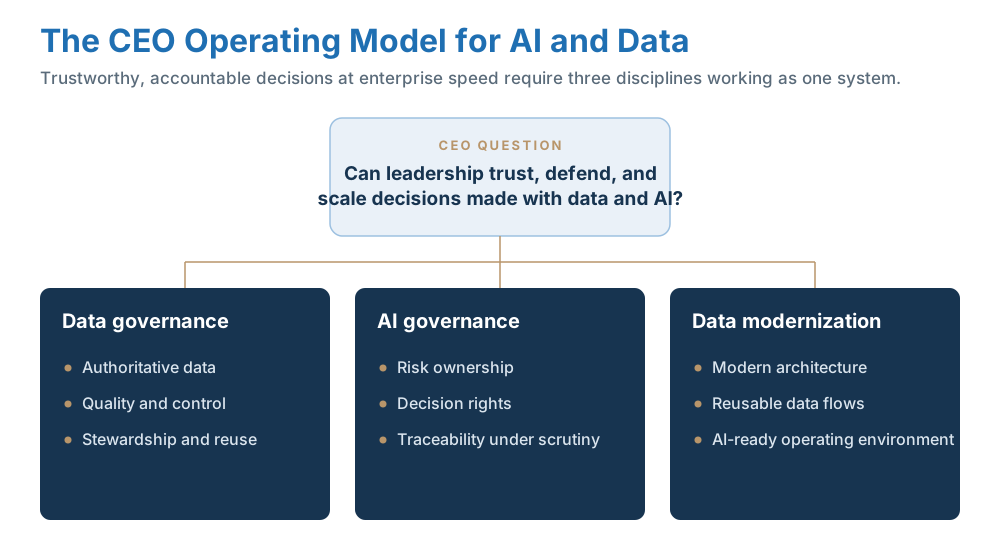
Enterprise speed is not the same as technical speed. A team can deploy models quickly and still create a slower company. A business can modernize platforms and still fail when decisions are challenged. An executive team can approve AI investments and still have no idea whether the organization is actually capable of using AI in a way that holds under pressure.
That is why CEOs should stop asking whether AI is moving fast enough. A better question is this: Can this company make decisions with data and AI that leadership can actually trust, defend, and scale? If the answer is no, then speed is an illusion.
The CEO’s AI problem is not primarily a technology problem
Most AI conversations still begin too low in the organization. They begin with tools, models, pilots, platforms, automation, use cases, architecture diagrams, and vendor claims. Those things matter. But they are not where the CEO’s real exposure begins.
Your exposure begins when the company starts using AI and data to influence decisions that matter: pricing, risk, customer treatment, forecasting, resource allocation, claims, underwriting, clinical prioritization, fraud detection, capital deployment, and operational judgment.
At that point, the issue is no longer whether the model performs in a lab. The issue is whether leadership can explain, defend, and stand behind the decision structure surrounding it.
That is not a data science question. It is not only a CIO question. It is not only a compliance question. It is a CEO question. Once decisions begin moving faster than the organization’s governance, accountability, and modernization maturity, the company does not become more advanced. It becomes more fragile.
CEOs do not need AI enthusiasm. They need an operating model
This is where many executive teams still go wrong. They treat AI as an innovation agenda and data modernization as an infrastructure agenda. Governance is handled separately. Data quality sits somewhere else. Accountability remains vague. Modernization is measured by migration. AI readiness is treated as a future-state aspiration.
The CEO actually needs an operating model that answers five questions clearly: Can the company identify authoritative data sources for important decisions? Can it trace how AI-driven outcomes were produced? Can leadership name who owns the decision, not just the process? Can the company scale AI without multiplying exceptions, rework, and political escalation? Can leadership defend the system under audit, regulatory inquiry, board scrutiny, or public challenge?
If those questions do not have good answers, then AI is outrunning the business. That is not acceleration. That is exposure.
Why data governance, AI governance, and data modernization must be led together
Too many organizations still treat these as separate initiatives. Data governance is framed as policy and stewardship. AI governance is framed as model review and risk control. Data modernization is framed as cloud migration, platform refresh, or architectural change.
But the CEO should see them differently. These are not separate programs. They are interdependent parts of the same executive requirement: the ability to make trustworthy, accountable decisions at scale.
Data governance determines whether the business knows what data is authoritative, trusted, and well-controlled. AI governance determines whether the business understands how AI is used, what risks are accepted, who owns the outcomes, and how decisions can be reconstructed later. Data modernization determines whether the architecture, data flows, and operating environment can actually support enterprise reuse, control, traceability, and AI scale without collapsing into one-off solutions.
If one of these is weak, the others do not save it. You cannot modernize your way out of weak accountability. You cannot govern your way out of broken architecture. You cannot scale AI on data no one fully trusts.
The CEO’s real concern is decision quality at enterprise speed
Speed is often misunderstood in executive conversations. Teams say they need to move faster. Boards ask about pace. Investors ask about adoption. Vendors sell acceleration. But speed at the enterprise level is not how quickly something goes live. It is how reliably the company can make decisions without having to unwind them later.
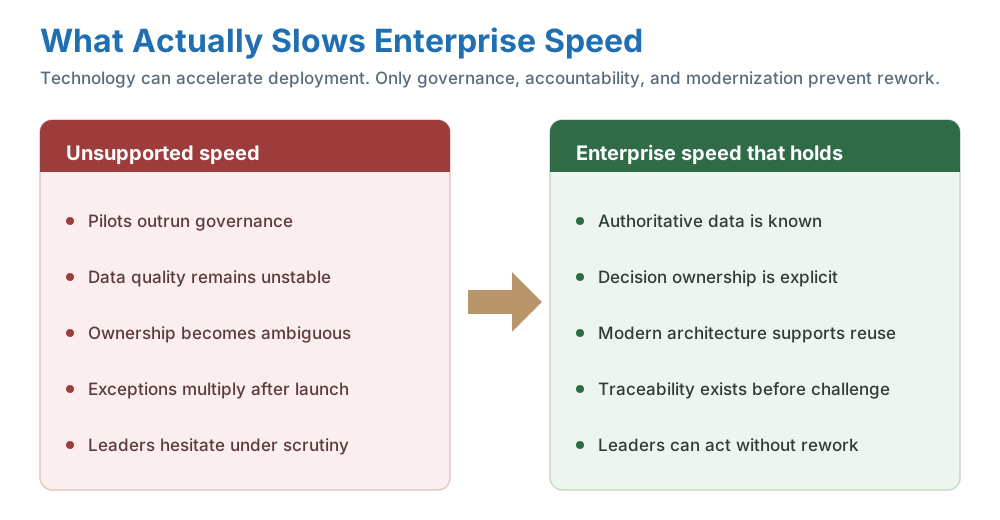
When the foundation is weak, decisions get revisited, definitions drift, exceptions multiply, escalations become political, leaders hesitate, teams work around governance, and AI outputs are questioned after deployment rather than before.
What actually slows companies down is rework, misalignment, unclear authority, weak modernization decisions, and data no one fully trusts. If AI and data are going to move at enterprise speed, leadership must create the conditions under which decisions can move once, stick, and hold under scrutiny.
What CEOs should actually ask their leadership teams
Most executive reviews on AI and data are still too operational. They ask: How many pilots do we have? What tools are in place? Have we migrated the platform? Do we have a governance committee? Are teams adopting AI? Those questions have value, but they are not enough.
A sharper CEO diagnostic sounds more like this: What are the most important decisions in this company that data and AI now influence? Which data sources are authoritative for those decisions? Where is decision ownership explicit, and where is it still assumed? If an outcome is challenged six months from now, can we reconstruct what happened without scrambling? Where are we modernizing platforms without modernizing accountability, quality, or trust? Where are we mistaking technical progress for operating readiness? If this use of AI doubled tomorrow, would the company scale confidently or fracture operationally?
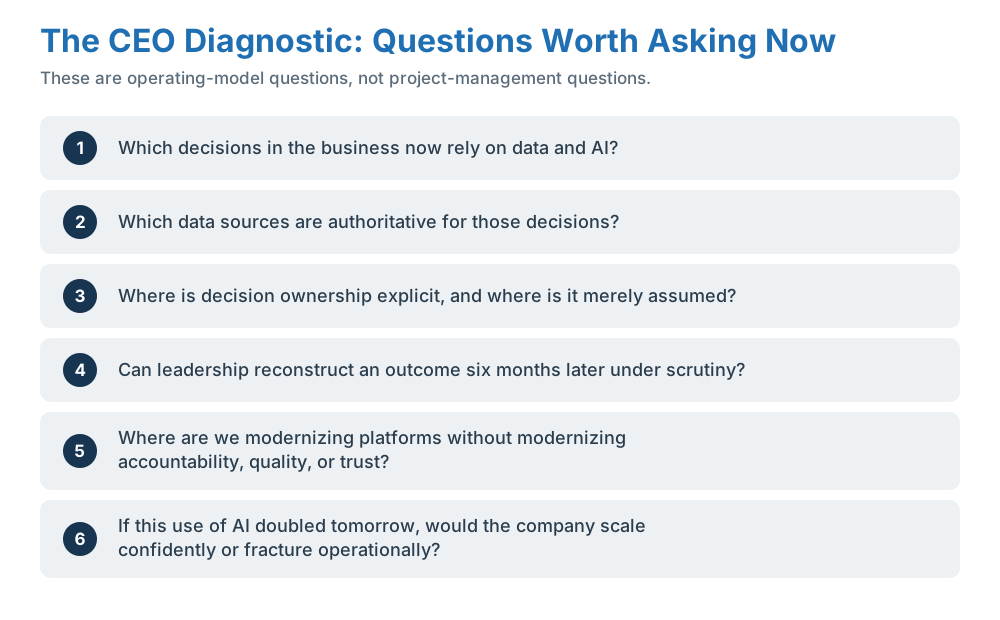
These questions do not slow the business down. They reveal whether the business is already slower than leadership thinks.
Data modernization is now a CEO issue
Many CEOs still think of data modernization as an internal technology effort. It is not. It is an enterprise capability issue.
A modernization program that only replaces platforms may reduce technical debt while preserving decision debt. It may create cleaner architecture while still leaving unclear ownership, unstable data quality, weak lineage, and no reliable way to defend AI-driven outcomes.
That is why modernization should not be judged by what got migrated. It should be judged by what the company can now do with confidence: Can decisions move faster without increasing risk? Can leadership trust the data behind important outcomes? Can AI scale without creating governance chaos? Can the company answer harder questions later, not just easier questions now?
From the CEO’s vantage point, modernization is successful only when it strengthens the company’s ability to operate, decide, and govern under pressure.
AI governance is not about saying no
Another mistake is that AI governance gets positioned as a limiting or gating function. It becomes the place where innovation goes to slow down. That framing is fatal.
When governance is treated as an obstacle, teams work around it. Shadow AI grows. Leaders lose visibility. Confidence erodes. And the business ends up slower, not faster, because clarity was never built into the operating model.
Good AI governance should do three things: make acceptable risk explicit, make ownership explicit, and make decisions explainable before they are challenged. That does not reduce speed. It is what makes sustainable speed possible.
If leadership cannot explain why an AI-driven decision happened, what data supported it, what assumptions were in play, and who owned the outcome, then the company is not moving fast. It is moving blind.
The CEO’s role cannot be delegated away
A CEO does not need to own every AI or data decision personally. But the CEO does need to own the operating model that makes those decisions trustworthy.
That means insisting on clarity where many organizations tolerate vagueness. Who owns the outcome? Who owns the data? Who can override the decision? Where does escalation end? What must be modernized first? What should be trusted, and why? What would fail first under pressure?
These are executive design questions. If they remain unresolved, leadership eventually gets pulled back in anyway, only later, under worse conditions, with more exposure and less room to maneuver.
That is why AI governance, data governance, and modernization cannot be delegated as separate technical agendas. They have to be integrated into the company’s leadership model.
The hard truth for CEOs
The companies that will benefit most from AI will not be the ones that move first. They will be the ones that can move fast without losing trust in their own decisions.
That requires authoritative data, clear accountability, decision rights, modern architecture, traceability, governance that holds, and leadership discipline.
As AI scales, more decisions will move faster, more outcomes will face scrutiny, and more companies will discover that what they thought was progress was actually unsupported speed.
The CEO’s job is not to champion AI in the abstract. It is to ensure the company can make trustworthy, accountable decisions with data and AI at enterprise speed. That is the operating model that matters. That is the leadership test.
“The CEO’s job is not to champion AI in the abstract. It is to ensure the company can make trustworthy, accountable decisions with data and AI at enterprise speed.”
For organizations trying to align AI governance, data governance, and modernization at the executive level, this is where CEO Advisory becomes necessary.