
Executive Summary for Boards
AI governance is often presented to boards as a management program: policies, committees, inventories, model reviews, vendor assessments, and acceptable use standards. Those activities matter, but they do not answer the question directors most need answered.
Can management govern the decisions AI will influence when those decisions become material, automated, customer-facing, regulated, or challenged?
That is the board-level issue.
AI governance becomes consequential when AI starts shaping decisions that affect customers, employees, capital allocation, pricing, credit, compliance, claims, operations, cybersecurity, reputation, or regulatory exposure. At that point, the board cannot rely on governance activity alone. It needs confidence that management has defined decision ownership, evidence standards, escalation paths, override rights, monitoring, and accountability before AI scales.
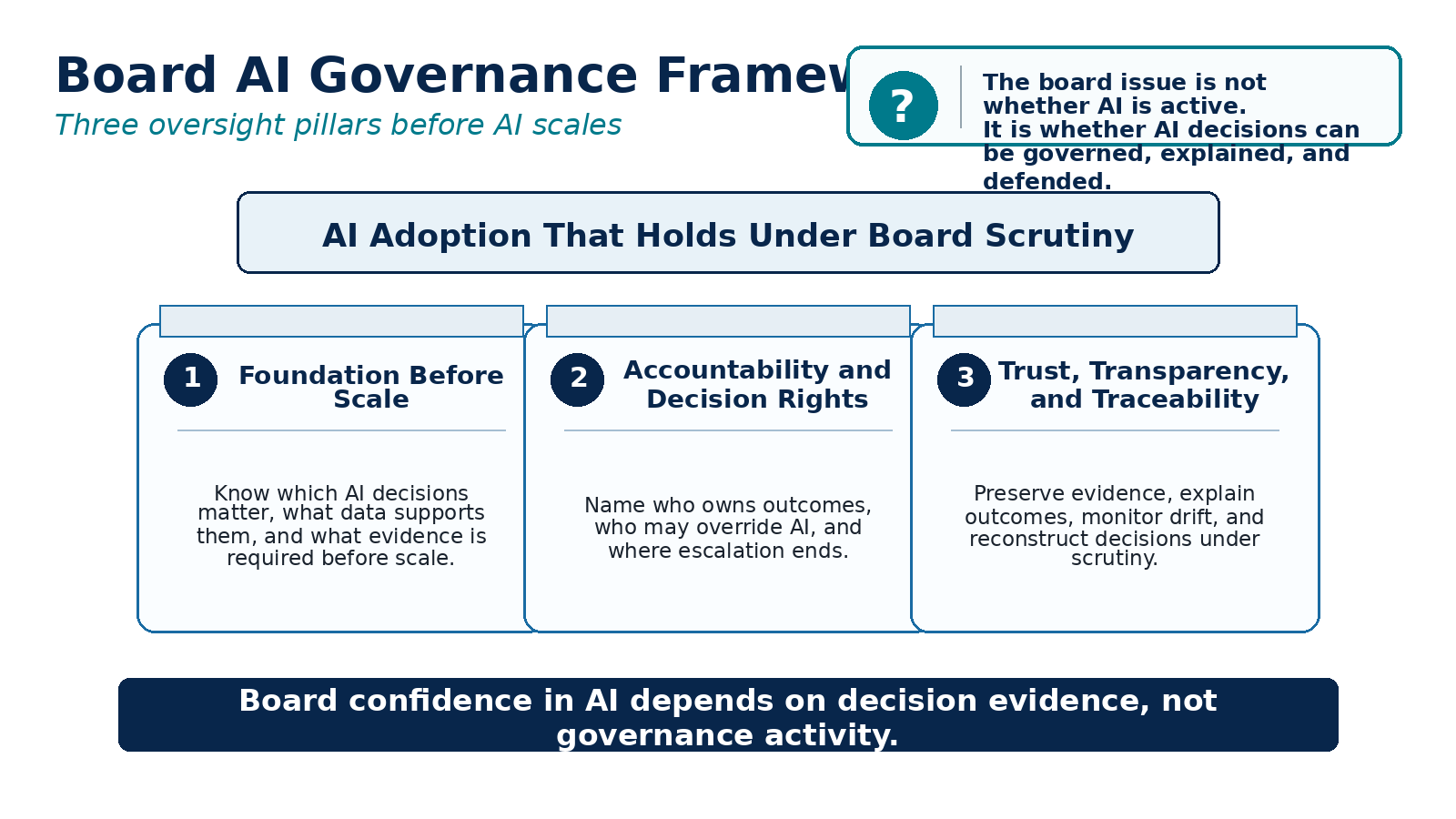
The three pillars boards should expect are:
- Foundation before scale
- Accountability and decision rights
- Trust, transparency, and traceability
Together, these pillars move AI governance from a checklist exercise to a board-relevant oversight framework. They help directors evaluate whether AI adoption can scale without losing accountability, confidence, or control.
Why AI Governance Is Now a Board Oversight Issue
Boards do not need to run AI governance. They do need to oversee whether management is governing AI at the right layer.
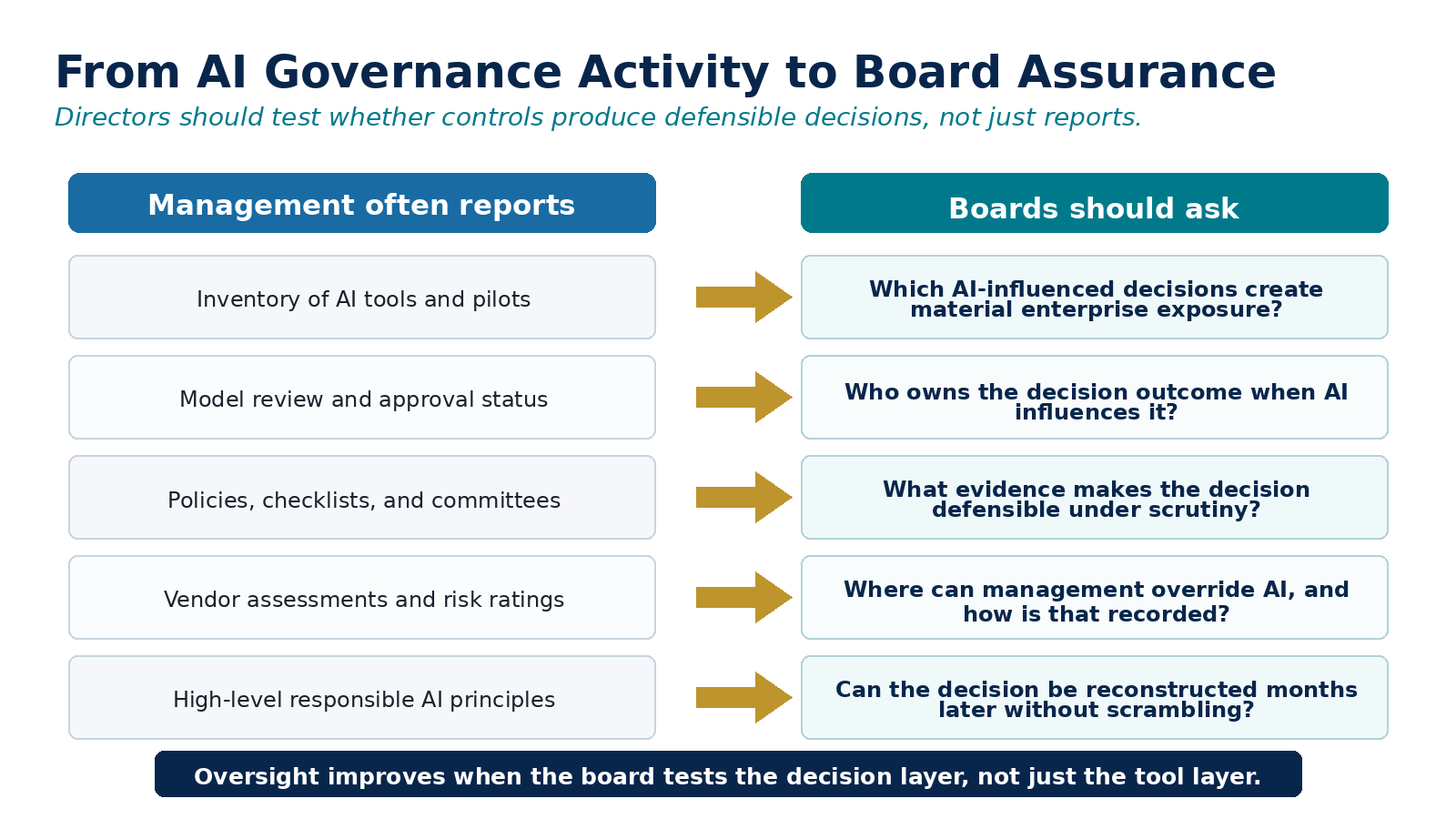
A tool inventory tells directors what AI exists. A policy tells directors what conduct is expected. A committee tells directors who meets. A model review tells directors what was evaluated. Those are useful inputs, but they are not the same as board assurance.
Board assurance requires a different question:
For the AI-influenced decisions that matter most, can management explain who owns the outcome, what data supports it, what evidence makes it defensible, who can override it, how performance is monitored, and where escalation ends?
This is where many AI governance programs remain underdeveloped. They govern tools and models, but not the decisions those tools and models influence.
That distinction matters because AI changes the speed, scale, and visibility of enterprise decisions. A manually reconciled analytics process may tolerate ambiguity for a while. AI-enabled operations do not. Once AI influences real decisions across functions, geographies, customers, and risk domains, vague ownership becomes board-relevant exposure.
The Board Risk in Tool-Layer Governance
Tool-layer AI governance is necessary. It usually includes inventories, vendor reviews, model assessments, acceptable use policies, security reviews, privacy checks, and approval workflows.
But tool-layer governance can create a false sense of readiness when the decision layer remains undefined.
The board should be careful when management describes AI governance mainly in terms of activity: how many tools were reviewed, how many pilots were approved, how many policies were published, or how many employees completed training.
Those are useful indicators, but they do not prove that the organization can defend AI-influenced decisions under pressure.
A stronger board conversation asks whether management has connected AI governance to:
- Material decision areas
- Named business owners
- Data readiness and lineage
- Evidence standards
- Human override rights
- Escalation paths
- Monitoring for drift, bias signals, and performance degradation
- Auditability and decision reconstruction
When AI influences decisions, governance must define accountability before scale.
The Three Pillars of Board-Level AI Governance
The three pillars give boards a practical oversight lens. They are not meant to turn directors into technologists. They are meant to help directors test whether management has built the operating conditions required for AI to scale responsibly.
Pillar 1: Foundation Before Scale
The first board question is not whether AI pilots are promising. It is whether the enterprise foundation can support AI decisions at scale.
Many organizations move quickly from experimentation to deployment because pilots appear successful. The board should ask whether those pilots are built on decision-ready data, clear use-case materiality, risk-tiering, defined controls, and evidence standards. A pilot can demonstrate technical potential without proving enterprise readiness.
For board oversight, foundation before scale means management can show:
- Which AI-influenced decisions are material to the enterprise
- How AI use cases are tiered by business criticality and risk
- What data sources support those decisions
- Whether definitions, lineage, quality thresholds, and access controls are reliable
- What minimum evidence must exist before an AI use case scales
- Which AI uses should remain experimental, limited, or paused until controls mature
The board does not need a data dictionary. It needs confidence that management knows where weak data could create weak decisions.
AI readiness is not only a model issue. It is a foundation issue.
Signals the Foundation Is Not Ready
Directors should listen for signs that AI scale may be ahead of organizational readiness:
- AI use cases are prioritized by enthusiasm, vendor pressure, or executive excitement rather than decision criticality
- Management can describe the model but not the authoritative data behind the decision
- Data quality is treated as cleanup after deployment rather than infrastructure before scale
- Lineage and access controls are incomplete for high-impact decisions
- AI governance is separated from enterprise data governance, privacy, cybersecurity, and modernization work
- Leadership asks whether AI is accurate but cannot define acceptable error thresholds for material decisions
When these signals appear, the board should not simply ask for slower AI adoption. It should ask for stronger readiness before scale.
Pillar 2: Accountability and Decision Rights
Accountability is the core differentiator between AI governance that looks mature and AI governance that holds under pressure.
Policies do not absorb outcomes. Committees do not explain customer impact. Model owners do not necessarily own business consequences. At board level, the question is whether management has named who owns the decisions AI influences.
Every material AI-influenced decision should have a clearly named outcome owner. That does not mean one person owns the entire AI ecosystem. It means someone owns the business decision, the accepted risk, and the consequences if the outcome is challenged.
For board oversight, accountability and decision rights mean management can explain:
- Who owns the AI-influenced decision outcome
- Who may approve scale, restriction, or suspension of the use case
- Who can override AI, under what conditions, and with what evidence
- What judgment is being delegated to AI: triage, recommendation, decision, or automation
- What issues require escalation to executives
- What issues require board visibility
- Who defends the decision under audit, litigation, regulatory inquiry, or public challenge
If accountability is distributed informally across IT, Data, Legal, Risk, Compliance, and the business, then accountability may disappear exactly when pressure rises.
That is when governance becomes coordination instead of control.
The Board Should Beware of Shared Accountability Without Final Authority
Boards often hear that AI governance is cross-functional. That is appropriate. AI risk often requires input from technology, data, legal, privacy, compliance, cybersecurity, risk, operations, and business leadership.
But cross-functional participation is not the same as final authority.
A governance model can involve many stakeholders while still requiring one accountable decision owner, clear escalation paths, and explicit override rights. The board should ask where consultation ends and decision authority begins.
If the answer is unclear, the governance model may be designed for alignment meetings, not enterprise accountability.
Pillar 3: Trust, Transparency, and Traceability
Trust is not a communication strategy. It is an operating condition.
Boards should expect management to preserve the evidence needed to explain, monitor, and defend AI-influenced decisions. This is especially important when AI decisions affect customers, employees, regulated activities, financial exposure, or reputational risk.
Trust requires:
- Transparency into the purpose, limits, and decision context of AI systems
- Traceability from data sources to outputs and outcomes
- Audit trails that capture meaningful decision evidence
- Monitoring for drift, bias signals, performance degradation, and unexpected impact
- Controls embedded in systems and workflows, not only in documentation
- A clear process for responding when outcomes are challenged
The board should not expect perfect certainty. It should expect disciplined evidence.
AI governance is mature when management can reconstruct why an AI-influenced decision was made, what data and assumptions informed it, what controls applied, who owned it, and what monitoring occurred after deployment.
Why These Pillars Matter More as AI Moves From Pilots to Operations
AI pilots often succeed in controlled conditions. They are smaller, closely monitored, and usually surrounded by motivated teams. Enterprise AI scale is different. It introduces broader impact, operational dependencies, regulatory complexity, customer visibility, and executive accountability.
Boards should treat the transition from pilot to scale as a governance threshold.
Before management moves material AI use cases into broader operations, directors should expect clear answers about foundation, accountability, and trust. Otherwise, AI may scale faster than the enterprise can govern.
The risk is not only that AI makes a bad recommendation. The larger risk is that the organization cannot explain, correct, override, or defend the decision once the issue becomes visible.
A Board-Level AI Governance Diagnostic
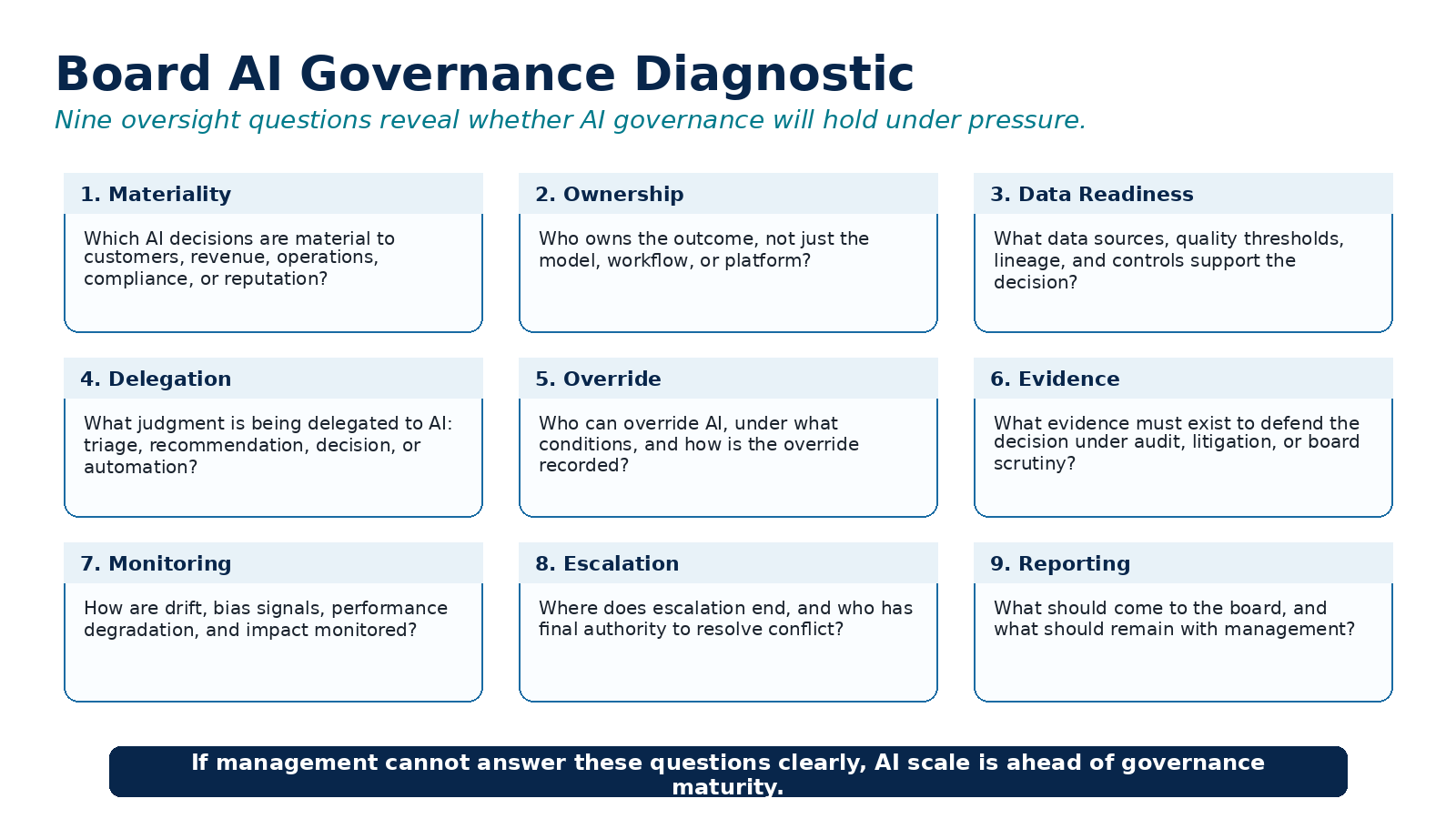
Directors can use a focused diagnostic to pressure-test whether AI governance is ready for scale. These questions are designed for oversight, not implementation.
- Which AI-influenced decisions are material to customers, revenue, operations, compliance, or reputation?
- Who owns each material AI-influenced decision outcome?
- What authoritative data, quality thresholds, lineage, and access controls support the decision?
- What judgment is being delegated to AI: triage, recommendation, decision, or automation?
- Who can override AI, under what conditions, and how is the override recorded?
- What evidence must exist to defend the decision under audit, litigation, regulatory inquiry, or board scrutiny?
- How are drift, bias signals, performance degradation, and unintended impact monitored?
- Where does escalation end, and who has final authority to resolve conflict?
- What should come to the board, and what should remain with management?
If management cannot answer these questions clearly for the most important AI use cases, the board should assume AI governance maturity is behind AI ambition.
What Boards Should Expect From Management
A strong board-level AI governance program does not drown directors in technical detail. It gives the board a clear view of material AI decisions, management accountability, governance maturity, and residual risk.
Boards should expect management to provide:
- A prioritized inventory of material AI-influenced decisions, not just an inventory of tools
- Risk-tiering that aligns governance effort to decision impact
- A named outcome owner for every material AI-influenced decision
- A data readiness view for high-impact AI decisions
- Defined override and escalation rules
- Evidence standards for defensibility
- Monitoring indicators for drift, bias signals, performance, and impact
- A clear distinction between management-level issues and board-level visibility
- A plan to integrate AI governance with data governance, privacy, cybersecurity, compliance, and enterprise risk management
This is not about turning the board into an AI review committee. It is about ensuring the board can oversee whether management has the right governance system for AI scale.
What Should Come to the Board
Boards should not receive every AI policy update, model review, or technical issue. That would bury directors in activity and weaken oversight.
Instead, board reporting should focus on matters that affect enterprise value, risk, reputation, legal exposure, or strategic direction. Useful board-level AI reporting may include:
- Material AI use cases moving from pilot to operational scale
- High-risk AI decisions affecting customers, employees, pricing, credit, claims, compliance, safety, or regulated activity
- AI use cases with unresolved data quality, lineage, privacy, security, or accountability risk
- Significant override patterns or exception trends
- Material drift, bias signals, performance degradation, or unexplained outcome changes
- Regulatory, audit, legal, or reputational issues connected to AI-influenced decisions
- Gaps in management accountability or escalation authority
- Progress against the three pillars of foundation, accountability, and trust
The board should not ask for more AI reporting by default. It should ask for more decision-relevant AI reporting.
The Committee Question
Many boards are still deciding where AI governance belongs. Audit committees may focus on controls, reporting, compliance, and assurance. Risk committees may focus on enterprise exposure. Technology committees may focus on architecture, cybersecurity, and innovation. Full boards may need to oversee strategy, reputation, and transformative adoption.
There is no single correct structure for every company. The important point is that the board explicitly decides how AI oversight is divided and where accountability returns to the full board.
AI governance can span multiple committees, but it should not become fragmented. Directors should clarify:
- Which committee oversees AI risk and controls
- Which committee oversees AI strategy and value creation
- Which committee receives reporting on AI incidents or material exceptions
- How AI governance connects to cybersecurity, privacy, data governance, compliance, and enterprise risk management
- When AI issues rise to the full board
If committee ownership is vague, board oversight can mirror the same accountability gaps that weaken management governance.
The Board’s Role: Govern the Conditions for Trust
Boards do not need to slow AI adoption. They need to ensure AI adoption is built on conditions that allow the enterprise to move with confidence.
That means directors should push management beyond broad statements about responsible AI and toward a concrete understanding of decision accountability. The board should know which AI decisions matter, who owns them, what evidence supports them, how they are monitored, and when unresolved issues require board visibility.
AI governance should not be measured by the amount of governance activity. It should be measured by whether AI-influenced decisions can hold under scale, automation, and scrutiny.
The organizations that succeed with AI will not be the ones with the most committees, checklists, or policies. They will be the ones that make better decisions faster because foundation, accountability, and trust are built into the operating model.
Related reading and advisory