
What directors should ask before AI-driven decisions scale beyond control
Executive Summary
AI governance and data governance have become board-level oversight issues because enterprise decisions are increasingly shaped by data, automation, analytics, and AI. For directors, the central question is no longer whether management has policies, committees, and review workflows. The real question is whether management can show who owns material AI- and data-driven decisions, who can override them, where escalation ends, and who can defend those decisions when they are challenged.
Decision authority is the missing link in many governance programs. Without it, oversight depends on reports of activity rather than evidence of control. With it, boards can pressure-test whether the enterprise is prepared to scale AI responsibly, make defensible decisions faster, and maintain confidence when outcomes are questioned.
Boards do not need more AI governance activity. They need evidence of who owns, overrides, escalates, and defends material decisions.
Why Decision Authority Belongs on the Board Agenda
Boards are overseeing organizations that increasingly rely on data-intensive and AI-enabled decisions. Those decisions may influence customers, employees, credit, pricing, clinical workflows, supply chains, cybersecurity responses, compliance monitoring, fraud detection, operational resilience, and financial performance.
This changes the nature of board oversight. AI governance and data governance are no longer narrow management disciplines. They are part of the enterprise control environment that determines whether leadership can explain, defend, and stand behind the decisions the organization makes.
Directors do not need to run AI governance programs. They do need to know whether management has designed governance in a way that holds when pressure arrives. A board that receives updates on model inventories, policy adoption, committee activity, and technology progress may still lack the most important answer: who has authority over the decision itself?
Governance does not become durable because a committee exists. It becomes durable when authority is explicit, conflicts have a defined end point, and accountability survives scrutiny.
The Oversight Risk Hidden Inside Approval-Based Governance
Many organizations present governance maturity through approvals. A proposed AI use case is reviewed. Legal signs off. Compliance signs off. Risk signs off. Technology signs off. Business stakeholders participate. Documentation is collected. A committee records a decision.
On paper, this can look reassuring. But approvals are not the same as accountability.
Approval-based governance can create the appearance of control while still avoiding the harder question: who owns the outcome? If everyone participates but no one owns the decision, the board is looking at coordination, not governance.
That distinction becomes visible when an outcome is challenged, an exception becomes public, or a regulator asks for evidence. In that moment, the question is not who attended the committee. The question is who had authority.
Approvals are not the same as accountability.
Why AI Raises the Stakes for Directors
Traditional analytics often gave organizations time to compensate for weak ownership. Reports could be reconciled manually, conflicting definitions could be debated over weeks, and senior leaders could absorb ambiguity through experience and judgment.
AI compresses that timeline. AI-enabled decisions can operate continuously, cross functional boundaries, influence customer or employee outcomes, and scale faster than traditional governance routines. The faster decisions move, the harder it becomes to tolerate unclear authority.
That is why AI governance cannot be reduced to model validation. Technical validation matters, but it does not answer the board’s core oversight concern. A model can be technically reviewed and still leave the enterprise unable to explain who owned the business decision, what tradeoffs were accepted, what data was authoritative, who could override the outcome, and who defends it under scrutiny.
If management cannot answer those questions before AI scales, AI has outrun governance.
If management cannot answer those questions before AI scales, AI has outrun governance.
What Decision Authority Means in Board Terms
Decision authority is the formal clarity around who owns a decision, who can influence it, who can override it, where conflict ends, and who is accountable for the outcome.
For boards, decision authority is not an administrative detail. It is the connection between governance design and management accountability.
A board-level decision authority lens asks whether management can demonstrate four things:
- The owner of each material AI- or data-driven decision is clearly named.
- Decision rights and override rights are documented and accepted.
- Escalation paths are short, bounded, and final.
- The organization can reconstruct the decision later, including data, assumptions, controls, tradeoffs, approvals, and accountability.
Without these conditions, governance may be active, but it is not yet board-ready.
A Board Oversight Framework for AI and Data Governance
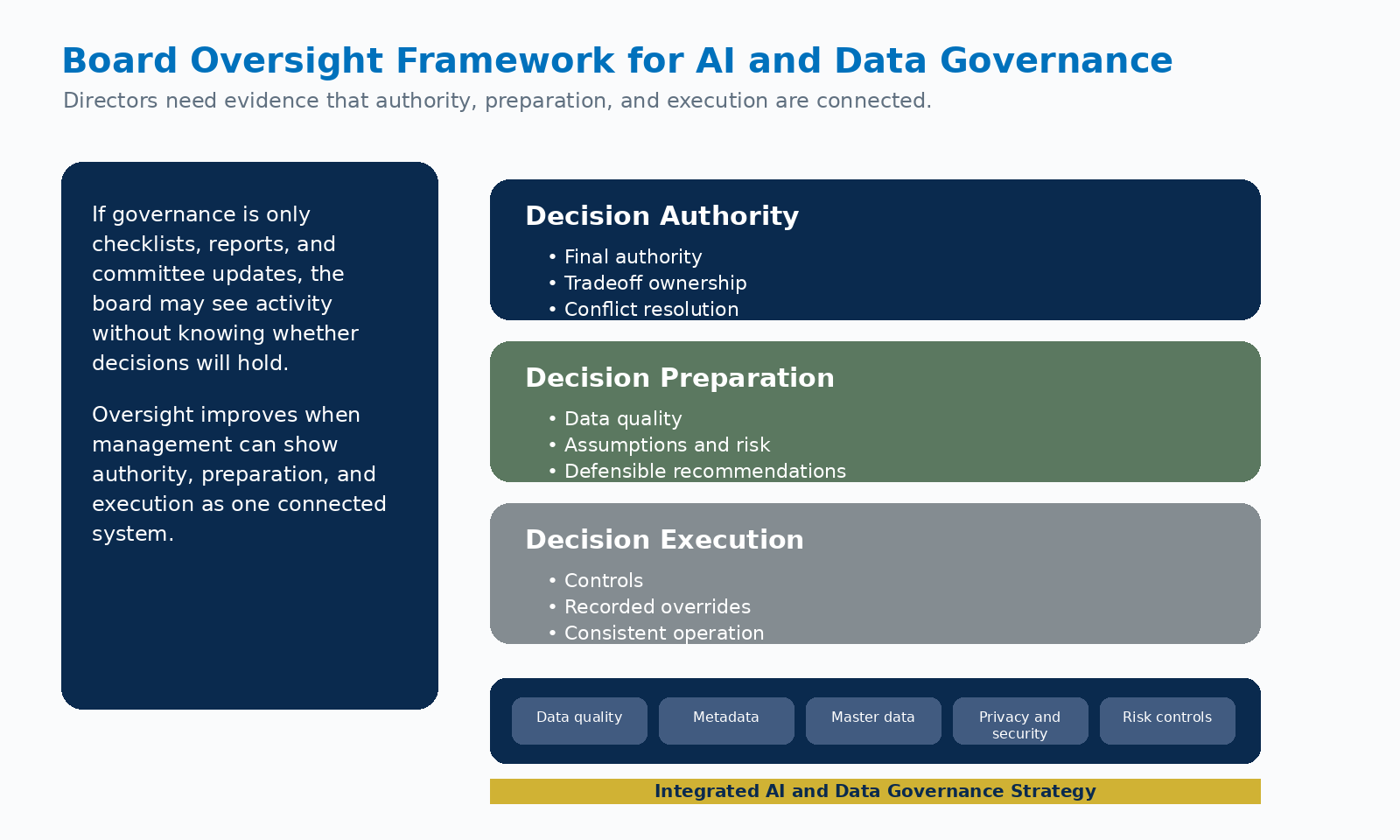
Boards can use a simple three-layer lens to evaluate whether AI and data governance are designed for durability.
Decision authority is where conflict ends. This layer determines who can make binding decisions, accept tradeoffs, resolve disputes across silos, and own outcomes when pressure arrives.
Decision preparation is where management creates clarity before decisions are made. This includes data quality, metadata, master data, privacy, security, risk analysis, assumptions, and the evidence needed for defensible recommendations.
Decision execution is where outcomes are enforced. This includes platforms, controls, automation, workflows, monitoring, exception handling, and operating discipline.
The board should be concerned when these layers are discussed separately. Authority without preparation leads to uninformed decisions. Preparation without authority leads to analysis without resolution. Execution without either leads to automated confusion at scale.
A durable governance model connects all three layers through an integrated AI and data governance strategy.
Four Questions Directors Should Ask Management
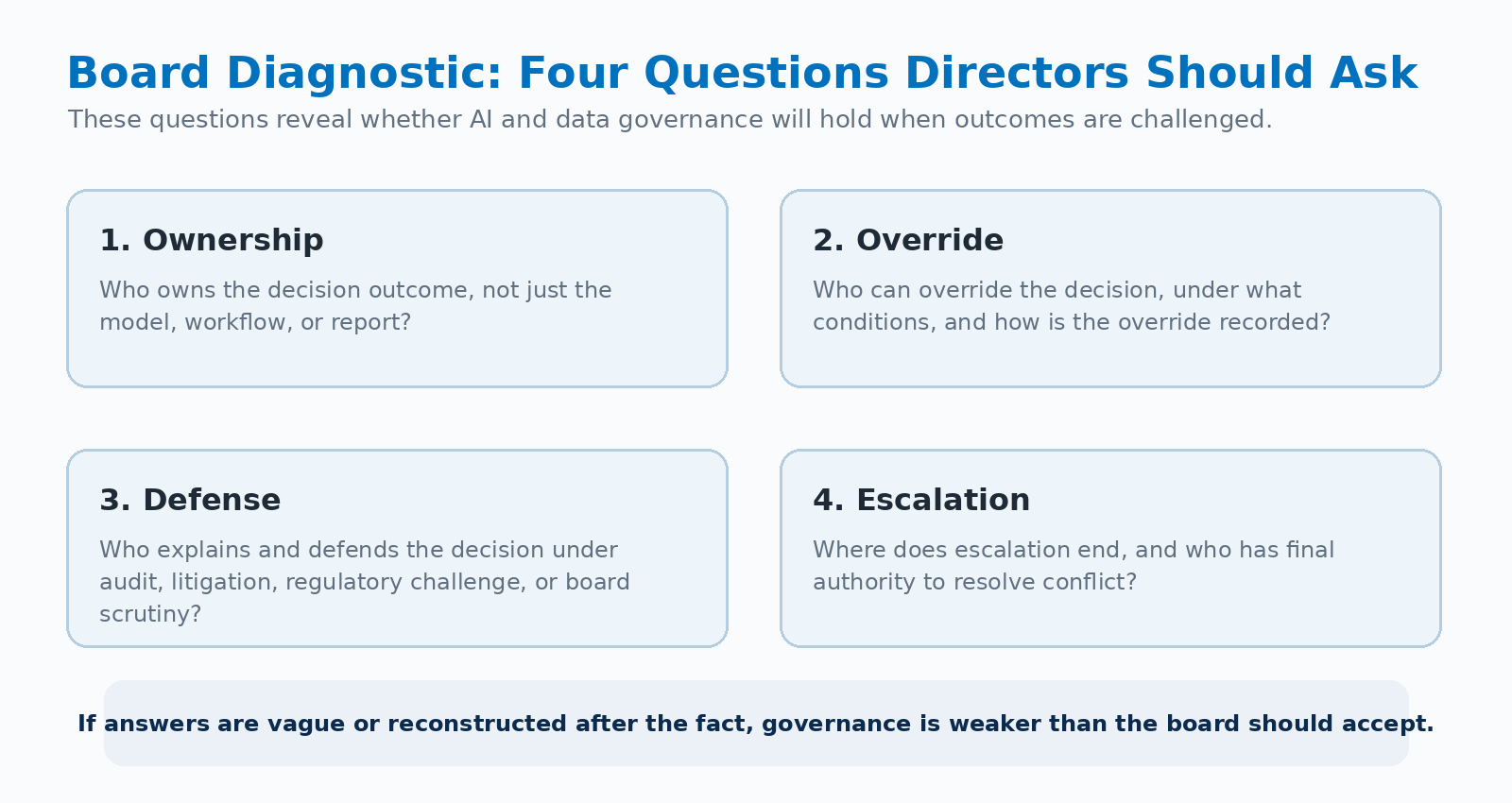
Directors do not need longer governance reports. They need sharper questions.
First, who owns the decision outcome, not just the model, system, report, or workflow?
Second, who can override the decision, under what conditions, and how is the override recorded?
Third, who explains and defends the decision under audit, litigation, regulatory challenge, customer challenge, or board scrutiny?
Fourth, where does escalation end, and who has final authority to resolve conflict?
If management answers these questions with a committee name, a shared responsibility statement, or a promise to reconstruct the details later, the board should treat that as a warning signal.
Shared participation is not the same as clear authority.
Shared participation is not the same as clear authority.
How Decision Authority Breaks Down in Practice
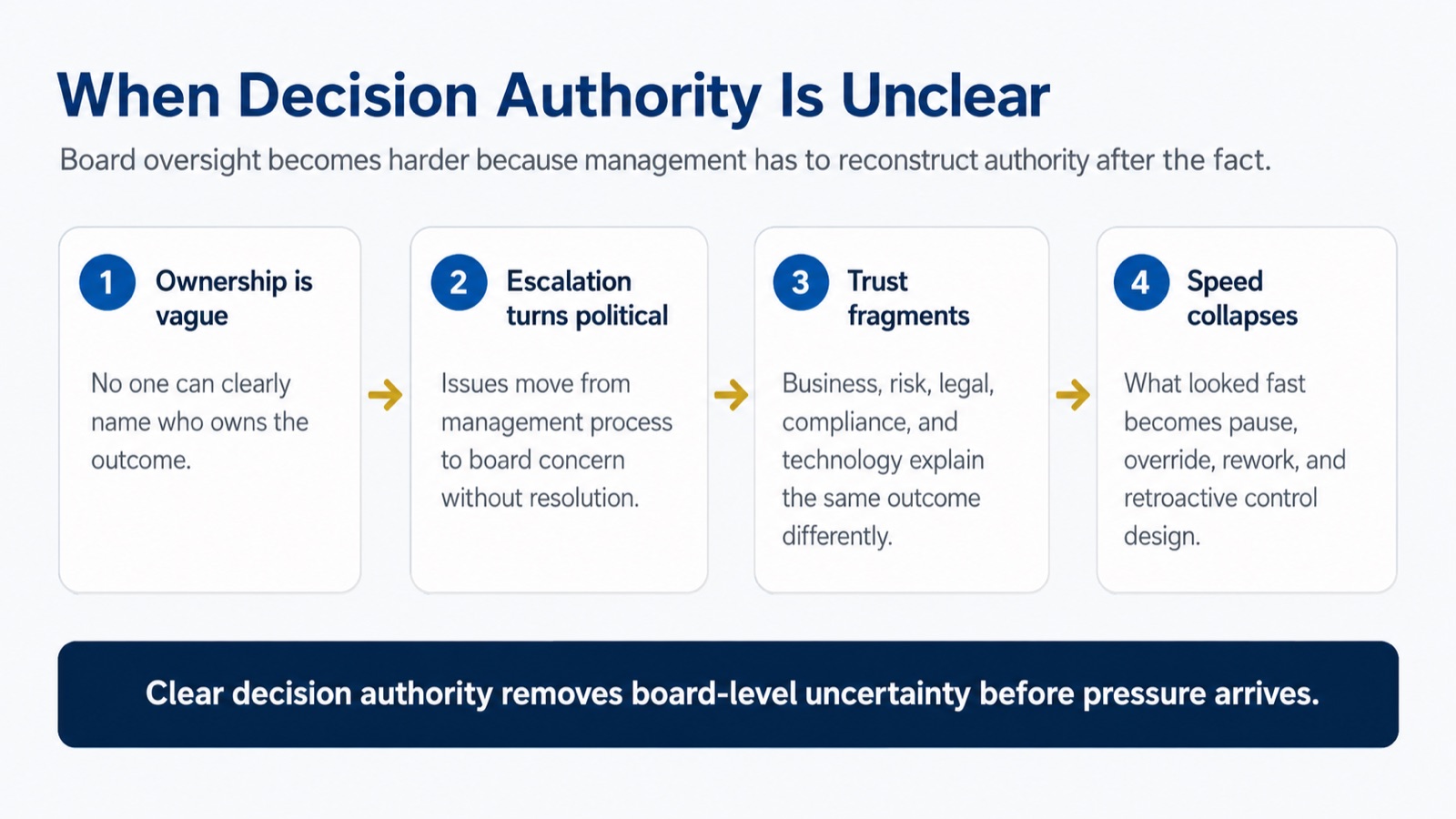
When decision authority is unclear, breakdown usually follows a recognizable pattern.
Ownership becomes ambiguous. No one can clearly name who owns the decision outcome. Escalation turns political. Issues move from management process to executive or board concern without resolution. Trust fragments. Business, risk, legal, compliance, and technology explain the same outcome differently. Speed collapses. What looked fast becomes pause, override, rework, and retroactive control design.
Boards often see the downstream symptoms: delayed AI scaling, unresolved risk exceptions, repeated management escalation, conflicting reports, unclear accountability, or hesitation around high-impact decisions.
Those symptoms are often misdiagnosed as culture, technology, or change management problems. In many cases, they are decision authority problems.
Clear decision authority removes uncertainty before pressure arrives.
What Management Should Be Able to Produce
A board does not need management to explain every detail of every AI model or data workflow. It does need management to produce evidence that decision authority exists for the decisions that matter most.
For material AI- and data-driven decisions, management should be able to show:
- The decision owner
- The authoritative data source
- The assumptions and constraints in play
- The advisory roles involved
- The approval and exception boundaries
- The override conditions
- The escalation path
- The controls and monitoring process
- The record needed to reconstruct the decision later
This evidence does not need to be theatrical. In fact, the best governance evidence is usually simple, clear, and repeatable.
If management cannot produce this view for the organization’s most important AI- and data-driven decisions, the board has reason to question whether governance will hold at scale.
Begin With a Material Decision Inventory
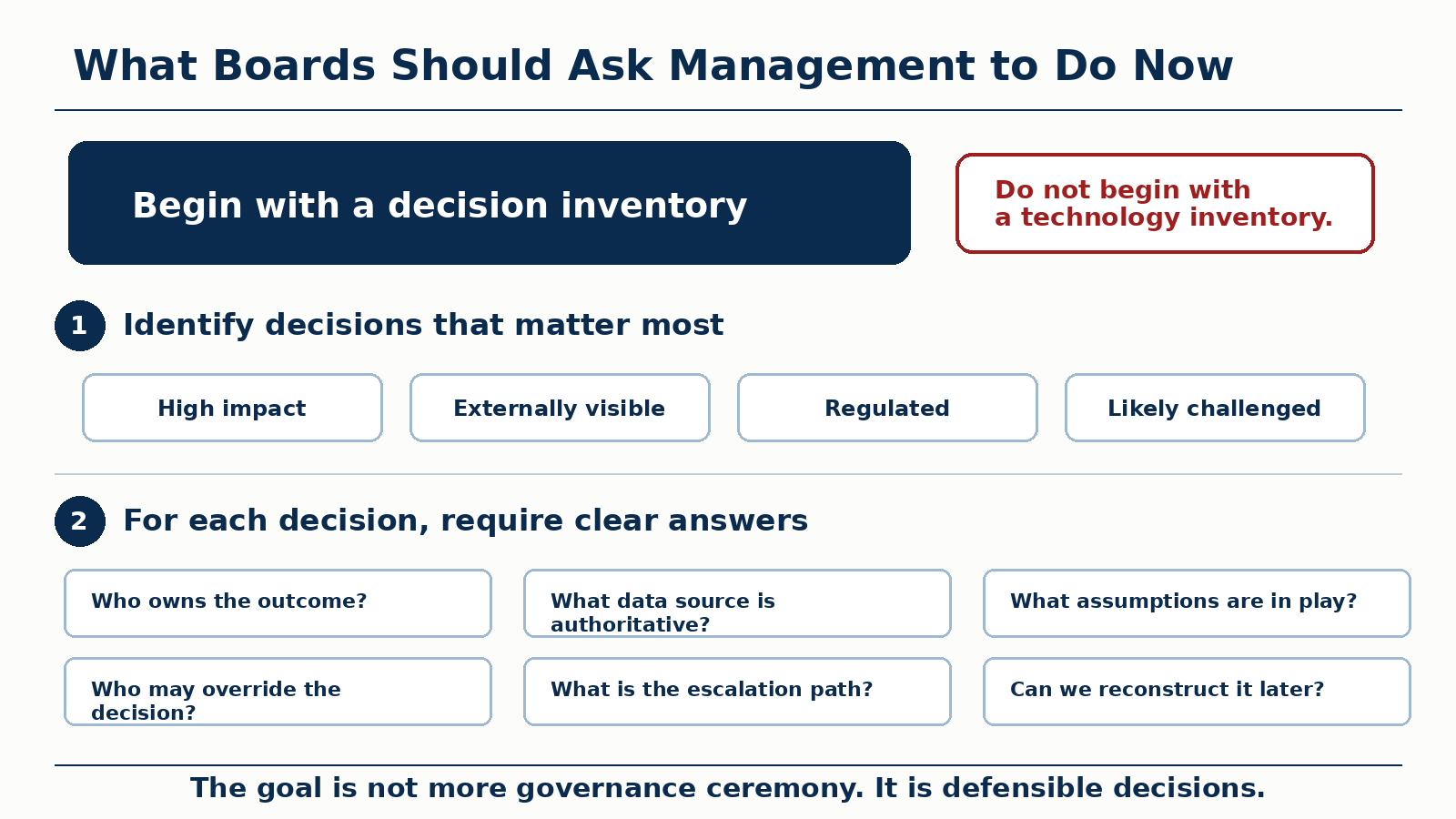
Boards should encourage management to begin with a material decision inventory rather than a technology inventory.
A technology inventory can show what systems, models, workflows, and platforms exist. That is useful, but it does not reveal whether the enterprise can explain and defend the decisions those technologies support.
A material decision inventory starts in a more board-relevant place. It identifies the decisions that carry the greatest enterprise consequence. Those decisions may be high impact, externally visible, regulated, likely to be challenged, tied to financial outcomes, connected to customer or employee treatment, or dependent on AI and automation.
For each decision, management should answer:
- Who owns the outcome?
- What data source is authoritative?
- What assumptions are in play?
- Who may override the decision?
- What is the escalation path?
- Can the organization reconstruct the decision months later under scrutiny?
The goal is not more governance ceremony. It is defensible decisions.
Board Oversight Cadence and Committee Fit
Boards should also clarify where decision authority oversight belongs.
Depending on the organization, oversight may sit with the full board, audit committee, risk committee, technology committee, compliance committee, or a combination of committees. The structure matters less than the clarity.
The board should avoid two failure modes. The first is fragmented oversight, where data governance, AI risk, cybersecurity, privacy, compliance, and technology modernization are reviewed separately without a common decision-accountability lens. The second is episodic oversight, where AI and data governance appear only as annual updates or project briefings rather than as part of ongoing enterprise risk and capability oversight.
A better cadence asks management to report not only on activity, but on authority. Which material decisions have been mapped? Which decision owners are named? Which override paths are defined? Which conflicts have a final decision maker? Which evidence can be produced on demand?
That is how the board moves from governance theater to governance confidence.
Signals That Governance Is Becoming Board-Ready
A board-ready AI and data governance program should produce visible signals of maturity.
Directors should look for management evidence that:
- Material decisions have clearly named owners.
- Decision rights and override rights are documented.
- Authoritative data sources are accepted across functions.
- Data quality expectations are tied to business decisions.
- Escalation paths resolve conflict rather than perpetuate it.
- Exceptions are recorded and reviewed.
- Decisions can be reconstructed months later without scrambling.
- AI use cases are tied to accountable business outcomes.
- Governance reduces hesitation rather than adding ceremony.
These signals help directors evaluate whether governance is becoming part of the enterprise operating model or remaining a set of administrative routines.
The Hard Truth for Boards
Most organizations do not fail because they lack AI ambition. They fail because they try to scale AI without first deciding how authority will hold when outcomes are challenged.
That is not merely a technical gap. It is an executive and board oversight issue.
If no one truly owns the decision, no one will trust it when pressure arrives. If leaders do not trust the decision, scale will stop. If the board cannot see how authority works, oversight becomes dependent on narrative rather than evidence.
Defining decision authority requires discipline, explicit design, and strong leadership. It does not require unnecessary bureaucracy.
The point is not to slow the enterprise down. The point is to make speed defensible.
Governance that holds under pressure is not built around obfuscation. It is built around decision authority.
Related reading and advisory